

An archive of unsolved mysteries, where the trail fades into shadow — separating fact from fiction.
Episode 04
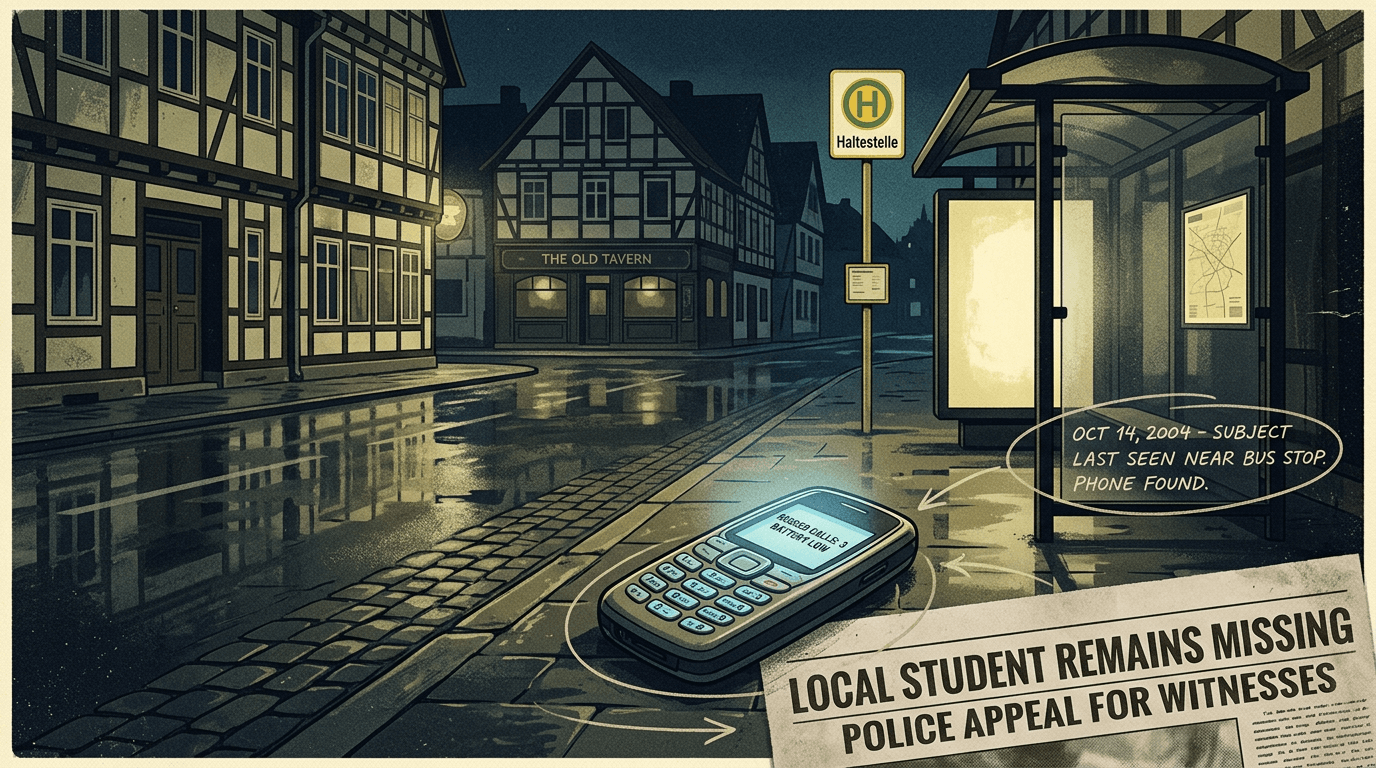
The Calls After Midnight
In June 2006, a 21-year-old nursing student vanished after watching a World Cup match in Paderborn, Germany. For days afterward, brief phone calls and text messages suggested she was alive — until her body was found months later, and the voice on the line became part of an unsolved murder mystery.
Case File at a Glance
On the evening of June 20, 2006, Germany was alive with World Cup fever. In Paderborn, 21-year-old nursing student Frauke Liebs met friends at an Irish pub to watch Sweden play England. It was an ordinary summer night, the kind that should have ended with a walk home, a message to a roommate, and sleep before the next day’s obligations. Instead, Frauke vanished somewhere between the pub and home.
What followed made the case unlike most missing-person investigations. Frauke did not simply disappear into silence. Over several days, her phone was used to send a text message and make a series of short calls to people close to her. The messages were brief, strangely calm, and emotionally difficult to interpret. They suggested she was alive — but not free. Then the contact stopped.
The Frauke Liebs Case in Brief
- Who was Frauke Liebs?
- Frauke Liebs was a 21-year-old nursing student from Paderborn, Germany.
- What happened to her?
- She disappeared on June 20, 2006, after leaving a pub in central Paderborn where she had watched a World Cup match with a friend. That night a text message was sent from her phone from the area of Nieheim, about 35 kilometers from Paderborn. In the following days she made several short phone calls to her flatmate, former partner and family. The last known call came on June 27.
- Was Frauke Liebs found?
- Yes. Her body was found on October 4, 2006, in a wooded area near Lichtenau. Because of the condition of the remains, the cause of death could not be determined. The case is treated as a homicide.
- Is the case solved?
- No. The murder of Frauke Liebs remains unsolved, and no one has been convicted.
Why This Case Still Resonates
The murder of Frauke Liebs remains one of Germany’s most unsettling unsolved cases because it contains a rare and painful contradiction: signs of life after disappearance, but no rescue. The calls gave her family hope while also deepening the fear that someone else was controlling the situation. Each contact appeared to place Frauke somewhere near Paderborn, yet police were unable to reach her before it was too late.
The case also resonates because Frauke was not a person living at the edge of society. She was a student, a daughter, a sister, a friend, and a young woman moving through a familiar city on a public night. Her disappearance challenged the comforting assumption that danger announces itself. In Frauke’s case, the boundary between normal life and violence may have been crossed in a matter of minutes.
Public interest has remained strong for years, partly because the phone contacts feel so close and yet so unreachable. They seem to offer a trail, but the trail dissolves. They show that someone wanted her absence managed, delayed, or explained — but not honestly.
The Night She Disappeared
Frauke Liebs was living in Paderborn and training as a nurse. On June 20, 2006, she spent the evening with friends at an Irish pub in the city center, watching a World Cup match between Sweden and England. After the game, she left the pub to go home. The walk was not long, and she was expected back by her roommate and former boyfriend, Chris.
She never arrived.
Later that night, shortly after midnight, a text message was sent from Frauke’s phone to Chris. The message indicated that she would come home later. It was short and, on the surface, reassuring. But the location data associated with the phone placed it not in central Paderborn, but in the area of Nieheim — a town roughly 35 kilometers away. This discrepancy became one of the first signs that something was seriously wrong.
Frauke had no known reason to be in Nieheim that night. She had reportedly left the pub with little money and no clear plan for an unexpected trip outside the city. The fact that her phone connected from that area suggested she had either traveled there voluntarily under circumstances not yet understood, or had been taken there by someone else.
The Calls That Followed
In the days after her disappearance, Frauke’s phone was used repeatedly. She contacted Chris several times, and in at least one call her sister was also involved. The calls were short. Frauke reportedly said she was okay, that she would come home, and gave little concrete information about where she was or who she was with. Those close to her felt something was wrong in her manner of speaking.
Investigators later examined cell tower data connected to these contacts. The phone appeared to connect from different areas around Paderborn and its surroundings, suggesting movement rather than one fixed location. This has long fueled the belief that Frauke may have been transported by car, possibly by someone familiar enough with the region to avoid immediate detection.
The final call came on June 27, 2006. According to accounts of that call, Frauke was asked whether she was being held against her will and is reported to have answered with a faint “yes,” followed by a louder “no.” This is a reported account rather than a verbatim transcript. The call ended without providing a location that could lead police directly to her. After that, there were no more messages, no more calls, and no confirmed sightings.
The phone contacts remain the emotional center of the case. They created a terrible form of suspense for her family and investigators: Frauke seemed alive, but every conversation was too brief, too controlled, and too empty of practical information. The calls did not solve the disappearance. They prolonged it.
The Discovery Near Lichtenau
On October 4, 2006, more than three months after Frauke disappeared, her body was found in a wooded area near Lichtenau-Herbram-Wald, southeast of Paderborn. By then, decomposition was advanced, and a precise cause of death could not be conclusively established publicly. Authorities treated the case as a homicide.
The location of the body added another layer to the geography of the case. Nieheim, Paderborn, and Lichtenau formed a triangle of movements or possible staging points. Investigators had to consider whether the offender lived in the region, worked there, knew secluded roads, or deliberately used locations that would confuse the search.
Frauke’s body being found months later also meant that key forensic opportunities had been lost. Time, weather, insects, and exposure can erase details that might otherwise identify a weapon, a restraint, a vehicle, or a precise timeline. In cold cases, the first hours are often decisive. In Frauke’s case, those hours were clouded by the belief — encouraged by the messages — that she might return.
Theories That Persist
The most widely discussed theory is that Frauke was abducted by someone she knew, or by someone with whom she felt safe enough to enter a vehicle. This theory is often raised because there were no public signs of a struggle on her route home, and because the offender seemed able to keep her alive and make calculated use of her phone over several days. However, no publicly confirmed evidence has identified such a person, and knowing the victim is only one possible interpretation.
Another theory holds that the offender was a local or regional perpetrator familiar with the area around Paderborn, Nieheim, and Lichtenau. The phone movements and later disposal site suggest geographical knowledge. Someone unfamiliar with the region might have struggled to move between those areas without attracting attention. Still, this remains an inference, not a proven fact. The offender could also have had temporary or professional reasons to know the area.
A further theory suggests that the phone calls were deliberately staged to delay the investigation. By having Frauke say she was alive and would return, the perpetrator may have hoped to reduce urgency, confuse the timeline, or create the impression that she had left voluntarily. This theory fits the pattern of repeated brief contacts but does not explain why the offender accepted the risk of turning on the phone multiple times. Each contact created a chance, however small, of detection.
Some speculation has focused on whether Frauke was held in a house, apartment, vehicle, or outbuilding. The calls sounded controlled, and she did not appear to speak freely. But the exact place of captivity has never been publicly established. Any claim naming a specific location without evidence should be treated with caution.
There have also been public discussions over whether the offender may have had emotional, sexual, or obsessive motives. These interpretations are common in cases involving young women held for several days, but motive remains unconfirmed. Without a conviction, confession, or conclusive forensic link, the responsible person’s reasons remain unknown.
Investigation and Public Appeals
German authorities have revisited the case repeatedly over the years, including through public appeals and television crime programs. The case has been covered widely in German media and remains familiar to many people who follow unsolved homicides. Investigators have received tips, examined timelines, and reviewed persons of interest, but no one has been convicted of Frauke’s murder.
One enduring challenge is the combination of partial information and missing context. The phone records show that Frauke’s mobile was active in certain areas at certain times. The calls provide fragments of speech. The body location provides an endpoint. But the connective tissue — who took her, where she was held, how she was moved, and why she was killed — is still absent.
In recent years, cold cases have increasingly benefited from improved forensic techniques, digital analysis, and renewed witness outreach. Yet the passage of time cuts both ways. Memories fade. Vehicles disappear. People move, die, or change their stories. At the same time, guilt, relationships, and secrets can weaken with age. Cases sometimes break not because new science appears, but because someone finally talks.
Where the Case Stands Today
Frauke Liebs’ case remains unsolved. She was found deceased, and her death is treated as a homicide, but the person responsible has not been brought to justice. Her final days are known only in fragments: a pub after a football match, a missing walk home, a text from the wrong place, several short calls, and then silence.
The central mystery is not only who killed Frauke, but why the offender allowed contact at all. The calls may have been meant to reassure, manipulate, delay, or torment. They may have reflected control, fear, improvisation, or a plan that changed over time. Each explanation is possible. None is proven.
What remains certain is the human reality behind the mystery. Frauke was 21 years old. She had a future, relationships, work, humor, ordinary routines, and people waiting for her to come home. For them, the phone calls were not clues in a puzzle. They were moments of hope that later became evidence of something unbearable.
Nearly two decades later, the case still asks the same questions it asked in June 2006: Who was with Frauke Liebs after she left the pub? Where was she held? Why was she allowed to call? And who has carried the answer all these years?
This case is documented in our archive
Explore Frauke Liebs alongside 30+ other unsolved cases in the STILL VANISHED True Crime Encyclopedia.
Books by Christian Hardinghaus

Crowdsolving True Crime Files
18 international cold cases explored in depth — plus a bonus collection of 20 lesser-known German cold cases rarely covered in English.
Book Details Get on Amazon
Still Lost in Panama
The definitive account of the 2014 disappearance of Kris Kremers and Lisanne Froon in the Panamanian jungle.
Book Details Get on AmazonLatest Update: Autumn 2024
In autumn 2024, a house in Lichtenau was searched. According to WDR, it was one of many leads that ultimately went nowhere, and there has still been no breakthrough in the investigation. Over the years the case has been featured in several TV programs, including ZDF’s “Aktenzeichen XY… Ungelöst” and an RTL documentary, and new tips have repeatedly come in after broadcasts. Source: WDR, “Verschwunden und ermordet: Der Fall Frauke Liebs” (in German).
Frequently Asked Questions
- Why are the phone calls so important?
- Unlike in most missing-person cases, Frauke stayed in contact for about a week after she disappeared. The calls suggest she was alive but not free. According to the investigators’ assessment, she was probably held near Nieheim, and the calls from the Paderborn area were likely meant to mislead the search.
- Was Frauke Liebs held captive?
- Investigators consider it likely that she was not acting freely during the calls. Where and by whom she was held has never been publicly established. Any claim naming a specific place or person should be treated as a theory unless it is backed by official findings.
- Who killed Frauke Liebs?
- The killer has never been identified or convicted. Several theories have been discussed over the years, but none has been proven.
- Are there suspects in the Frauke Liebs case?
- Police questioned more than 900 people and examined several early suspects, but no one has been convicted. Public naming of individuals should be clearly separated from confirmed police findings.
- Where was Frauke Liebs’ body found?
- In a wooded area near Lichtenau, southeast of Paderborn, on October 4, 2006. The remains had been exposed for months, which limited the available forensic evidence.
- What is the latest update?
- The case remains open and unsolved, and no arrest or conviction has been publicly announced. A house in Lichtenau was searched in autumn 2024 without a breakthrough (see the update above).
This article is based on publicly available sources and is presented with respect for those affected. Where theories or unconfirmed claims are discussed, they are clearly identified as such. It serves informational and documentary purposes. If you have information related to this case, please contact the relevant authorities.