

An archive of unsolved mysteries, where the trail fades into shadow — separating fact from fiction.
Episode 05
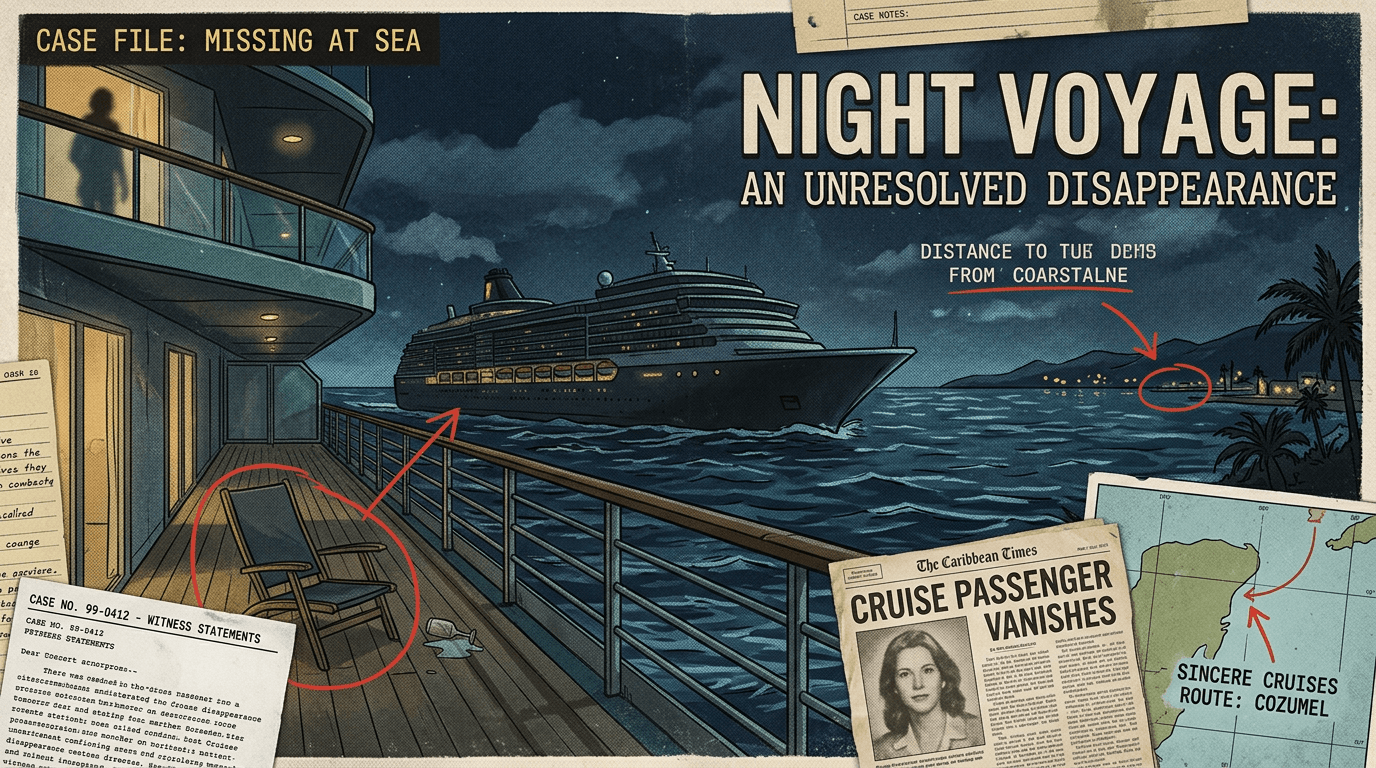
Amy Lynn Bradley: Still Missing From a Cruise Ship
In March 1998, 23-year-old Amy Lynn Bradley disappeared from a Royal Caribbean cruise ship as it approached Curaçao. She was last seen on the balcony of her family’s cabin before dawn. Decades later, alleged sightings and unanswered questions continue to keep her case alive.
Case File at a Glance
There are disappearances that seem to happen in the wilderness, where distance and terrain can swallow evidence. Others unfold in cities, where anonymity becomes part of the mystery. Amy Lynn Bradley vanished in a place that should have been contained: a cruise ship at sea, surrounded by her family, passengers, crew, cameras, corridors and locked doors. And yet, sometime before sunrise on March 24, 1998, she was gone.
Amy was 23 years old, from Petersburg, Virginia, and traveling with her parents, Ron and Iva Bradley, and her younger brother Brad aboard Royal Caribbean’s Rhapsody of the Seas. The ship was on a Caribbean cruise and was approaching Curaçao when Amy disappeared. Her family has always insisted that she would not have voluntarily abandoned them, and that she was a strong swimmer who was not likely to have accidentally fallen overboard without leaving clearer evidence behind. Officially, however, her fate remains unknown.
Why This Case Still Resonates
Amy Lynn Bradley’s case continues to resonate because it sits at the uneasy intersection of a family vacation and a nightmare scenario: a young woman vanishing from a crowded ship just before it docked. Cruise ships are often imagined as controlled environments. They have passenger lists, crew rosters, schedules, security protocols and physical boundaries. In theory, those features should narrow a disappearance down. In Amy’s case, they only sharpen the mystery.
The case also endures because of what came after. Over the years, several people have reported possible sightings of Amy in the Caribbean. Some of these claims were investigated and could not be confirmed. Others remain part of the public lore around the case. The most disturbing theory holds that Amy may have been abducted and forced into exploitation after the ship reached port — a possibility her family has publicly considered and one that has shaped much of the public attention surrounding the case. It is important to state clearly: no confirmed evidence has established what happened to Amy after she disappeared.
The Night Before: Dancing, Music and a Family Vacation
On the evening of March 23, 1998, Amy and her brother reportedly spent time at the ship’s nightclub, where a live band was performing. Accounts from the family and later reporting indicate that Amy danced that night and socialized in the public areas of the ship. She returned to the family cabin in the early morning hours.
Her father, Ron Bradley, later stated that he saw Amy asleep or resting on the balcony of their cabin in the pre-dawn hours. Around 5:30 a.m., according to commonly reported timelines, she was still there. When he woke again a short time later, Amy was gone. Her shoes and some personal belongings were reportedly still in the cabin, but cigarettes and a lighter may have been missing. The balcony door was open. The ship was approaching Curaçao.
The family quickly began looking for her. They notified ship personnel and asked that passengers not be allowed to leave until Amy had been found. According to the Bradley family, they were deeply concerned that the ship docked and passengers disembarked before a full search could resolve what had happened. Royal Caribbean has stated in past reporting that the ship was searched, but Amy was not located.
The Timeline: A Narrow Window at Sea
The known timeline is narrow but deeply troubling. Amy was with her family aboard the Rhapsody of the Seas. She was seen in the early hours of March 24. She was believed to have been on the balcony shortly before dawn. Then, in the period before the ship fully docked in Curaçao, she disappeared.
There are only a few broad possibilities in such a setting. Amy could have gone overboard, whether accidentally, voluntarily or through foul play. She could have left the cabin and encountered someone on the ship. She could have been taken off the vessel after docking. Each possibility raises its own problems. An overboard scenario has long been discussed, but her body was never recovered, and her family has emphasized her swimming ability and the lack of obvious signs that she had simply fallen. A voluntary disappearance is viewed with skepticism by her relatives, who argue that Amy was close to her family and had no reason to vanish permanently. Abduction remains the most frightening theory, but it has never been proven.
The case soon drew the attention of the FBI, and Amy was later featured in missing-person alerts and media coverage. The FBI has continued to list her as missing and has offered a reward for information leading to her recovery or to the resolution of the case. Her disappearance remains one of the most widely known cruise-ship missing-person cases in modern true crime.
Theories and Alleged Sightings
One theory holds that Amy accidentally fell from the balcony or another area of the ship. This is often the simplest explanation in cruise-ship disappearances, and it cannot be ruled out as a general possibility. However, critics of this theory point to the absence of a recovered body, the lack of definitive physical evidence publicly confirming a fall, and Amy’s family’s belief that she would not have placed herself in obvious danger. None of those points disproves an accident, but they explain why many researchers remain unconvinced.
A second theory suggests suicide or voluntary disappearance. This has also circulated over the years, as it often does in missing-person cases where a person vanishes without a clear witness to a crime. Amy’s family has strongly rejected the idea that she intended to disappear or harm herself. Publicly available accounts describe her as close to her family and planning her future. There is no verified evidence showing that Amy planned to leave her life behind.
The most persistent theory is that Amy encountered someone on the ship and was abducted, possibly before or shortly after the vessel reached Curaçao. This theory is partly fueled by later alleged sightings. Several people have claimed over the years that they saw a woman resembling Amy in the Caribbean, including reports from Curaçao and Barbados. Some accounts describe a woman who appeared distressed or who allegedly identified herself as Amy. These reports have never been publicly confirmed as definitive, but they remain central to the family’s belief that Amy may have survived after March 24, 1998.
One of the most widely circulated alleged sightings involves a U.S. Navy sailor who reportedly claimed he encountered a woman in a Caribbean brothel who said her name was Amy Bradley and asked for help. This account has been repeated in media coverage and online discussions, but it remains an unconfirmed report rather than established fact. Another strand of speculation focuses on photographs found online years later that some believed resembled Amy. Again, those images have never been confirmed to show her.
There has also been public discussion about individuals Amy interacted with on the ship, including members of the entertainment staff. Some reports have named a band member who had spoken or danced with her before she disappeared. It is important not to overstate this. Interaction with Amy does not establish guilt, and no publicly available evidence proves that any specific crew member or passenger caused her disappearance. In a case like this, the distinction between a lead, a rumor and an accusation matters.
What Is Known — and What Remains Unproven
The known facts are stark. Amy Lynn Bradley was on the Rhapsody of the Seas with her family. She was last seen in the early morning hours of March 24, 1998, as the ship approached Curaçao. She disappeared before the day properly began. She has never been found.
Beyond that, the record becomes less certain. Alleged sightings suggest possibilities, not conclusions. Theories of trafficking, abduction, accident or voluntary disappearance each attempt to explain the same absence. But none has been confirmed by publicly available evidence. This is why Amy’s case remains so haunting: it has many fragments, but no final shape.
The cruise-ship setting adds another layer of unease. A vessel is both public and private, open and sealed, transient and crowded. People meet briefly, then scatter across countries and oceans. Crew members change ships. Passengers return home. Memories fade. By the time investigators begin reconstructing a disappearance, the scene itself may already be gone.
Where the Case Stands Today
Update (April 2026): New Movement in the Case
In April 2026, private investigator Jim Carey, hired by the Bradley family, handed the FBI a list of two people of interest: a police employee and a taxi driver who had claimed to have seen Amy after her disappearance. Based on the reports available, the FBI has not confirmed this; these are leads, not evidence.
The FBI has raised its reward for information leading to the recovery of Amy Lynn Bradley from $25,000 to up to
Where the Case Stands Today
00,000. The case also drew fresh attention in 2025 through a Netflix documentary.Amy Lynn Bradley remains missing. The FBI continues to maintain information about her case, including identifying details such as her tattoos and physical description. She was 23 years old at the time of her disappearance, with short brown hair and green eyes. She had several tattoos, including a Tasmanian Devil spinning a basketball on her shoulder, a sun on her lower back, a Chinese symbol on her right ankle and a gecko around her navel.
Her family has never stopped searching. Over the years, Ron and Iva Bradley have appeared in interviews, supported media coverage and urged anyone with information to come forward. Their position has remained consistent: Amy did not simply choose to disappear. They believe someone knows what happened.
More than a quarter-century later, the central question remains painfully simple. How did a young woman vanish from a cruise ship in the narrow hours before docking — and why has no confirmed trace of her ever surfaced? Until there is evidence strong enough to answer that question, Amy Lynn Bradley’s disappearance remains suspended between fact and fear, between the known movements of a family vacation and the shadows that followed.
This case is documented in our archive
Explore Amy Lynn Bradley alongside 30+ other unsolved cases in the STILL VANISHED True Crime Encyclopedia.
Books by Christian Hardinghaus

Crowdsolving True Crime Files
18 international cold cases explored in depth — plus a bonus collection of 20 lesser-known German cold cases rarely covered in English.
Book Details Get on Amazon
Still Lost in Panama
The definitive account of the 2014 disappearance of Kris Kremers and Lisanne Froon in the Panamanian jungle.
Book Details Get on AmazonThis article is based on publicly available sources and is presented with respect for those affected. Where theories or unconfirmed claims are discussed, they are clearly identified as such. It serves informational and documentary purposes. If you have information related to this case, please contact the relevant authorities.