

An archive of unsolved mysteries, where the trail fades into shadow — separating fact from fiction.
Episode 06
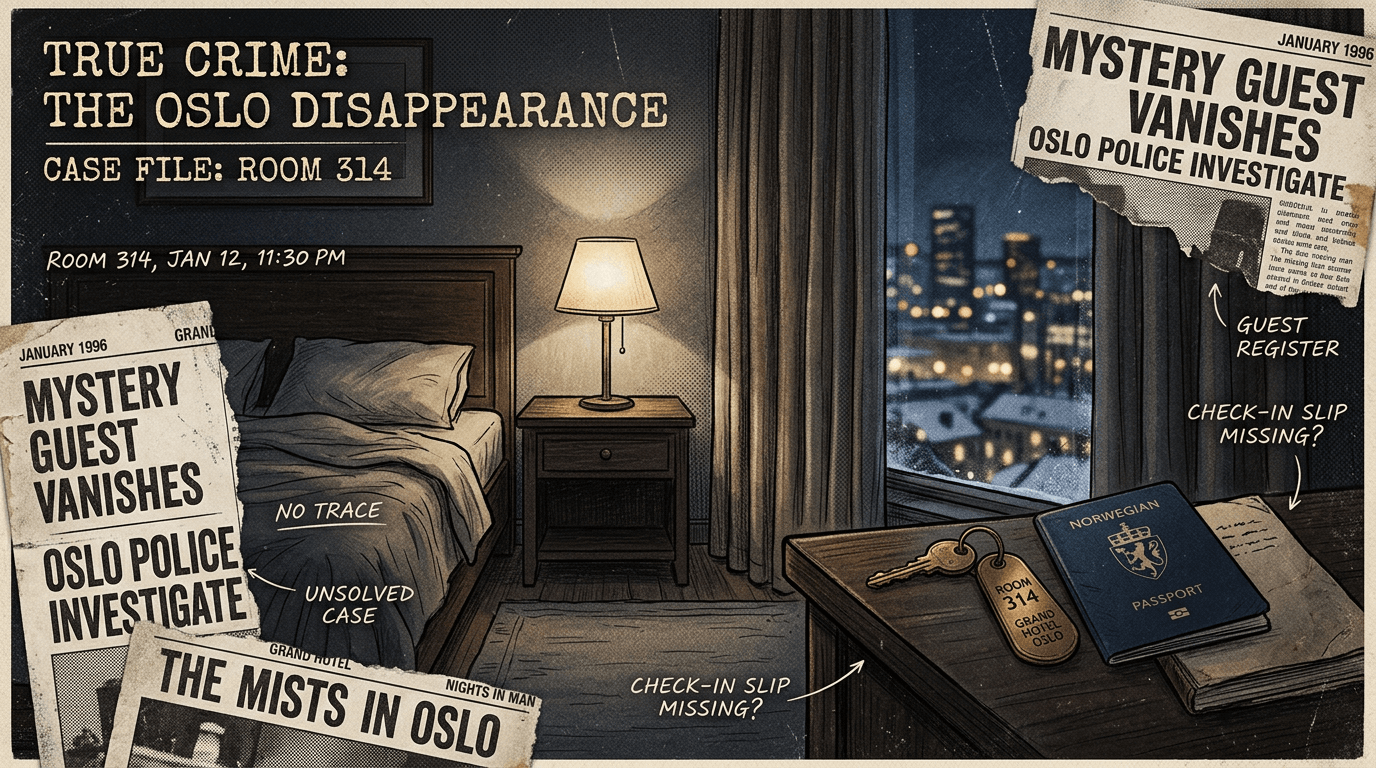
Jennifer Fergate: The Unidentified Woman in Room 2805
In June 1995, a woman checked into Oslo’s luxury Plaza Hotel under a name that may not have been hers. Three days later, she was found dead behind a locked door, with no identification, no labels in her clothes, and a trail that still leads nowhere.
Case File at a Glance
At first glance, the case seemed contained: one hotel room, one dead woman, one firearm, one apparent answer. A guest at the Oslo Plaza Hotel had been found with a gunshot wound to the head, and the door to her room was locked from the inside. But almost every detail around her death complicated the simplest explanation. The woman had no passport, no wallet, no credit cards, and no usable proof of identity. The name she gave at check-in — usually reported as Jennifer Fergate, sometimes rendered as Jennifer Fairgate — has never been confirmed as real.
She had entered one of Norway’s most prominent hotels and, within days, disappeared from the world in a different way: not by leaving, but by dying as someone no one could name. Nearly three decades later, the woman in Room 2805 remains one of Scandinavia’s most haunting unidentified-person cases.
Why This Case Still Resonates
The Jennifer Fergate case persists because it sits at the intersection of forensic mystery, hotel security, Cold War atmosphere, and human anonymity. It is not merely the question of how she died, but who she was — and why so many traces of ordinary life appear to have been missing or deliberately removed.
The setting adds to the unease. The Oslo Plaza was not an obscure lodging house, but a high-end international hotel connected to business travel, diplomacy, and wealth. A woman checked in without producing a verified identity document, gave an address that later appeared doubtful or false, and was reportedly accompanied on the registration form by a man named “Lois Fergate,” whose existence has never been established. No one matching that name has ever come forward.
Unlike many unidentified decedent cases, Fergate’s body was not found in a remote forest, a river, or a place where the elements erased context. She was found in a controlled urban environment, in a luxury hotel room, surrounded by objects that should have made identification easier. Yet those objects did the opposite. They deepened the silence.
The Woman Who Checked Into Room 2805
On May 31, 1995, a woman checked into the Oslo Plaza Hotel under the name Jennifer Fergate. She reportedly gave her nationality as Belgian and provided an address connected to Verlaine, Belgium, though later inquiries failed to confirm her identity through those details. Her room was 2805, a high-floor room overlooking the city. The registration also included the name “Lois Fergate,” listed as if another guest were connected to the stay. Whether this person ever existed, was present, or was merely part of a false identity remains unknown.
Hotel staff later described the woman as well-dressed and composed. She appeared to move through the hotel without drawing alarm. Yet there were irregularities. Her stay was not secured in the usual way, and by June 3 staff had reason to check on the room because payment had not been settled. When hotel security approached Room 2805, the situation quickly escalated from routine hotel administration to death investigation.
Accounts of the final moments vary in small details across reports, but the core sequence is widely known: a security employee went to the door, knocked, and shortly afterward a gunshot was heard from inside the room. When police entered, they found the woman dead on the bed. A handgun was present. The door had been locked from the inside. These facts led investigators toward the possibility of suicide, but the surrounding circumstances prevented the case from closing cleanly.
The weapon was a Browning-type semi-automatic pistol, and a gunshot wound to the forehead was recorded. Reports have long noted the unusual handling of the firearm and the absence of obvious identifying material. There was no passport in the room, no travel documents, no keys that clearly connected her to a home, and no wallet containing the mundane paperwork most travelers carry almost without thinking. Her clothing reportedly had labels removed, a detail that has become central to later theories.
Objects, Absences, and the Strange Inventory
Many mysteries are built around what is found. Jennifer Fergate’s case is built just as strongly around what was not. The room contained clothing, toiletries, and travel-related items, but not the anchors of identity investigators expected. No one could confirm her background through documents. No family reported her missing under that name. No Belgian connection produced a woman who fit the case.
Some items seemed ordinary at first but became suspicious in context. Clothing labels had reportedly been removed from several garments. This could mean little in isolation: people remove tags for comfort, irritation, or style. But in a case where nearly every identifying marker was absent, the missing labels appeared more deliberate. Investigators and later researchers have also noted the lack of lower-body clothing items compared with the rest of her wardrobe, another detail that has generated speculation but has not produced a confirmed explanation.
Her physical appearance has been widely described in public reconstructions: a woman estimated to be in her mid-20s to early 30s, with dark hair and a polished presentation. Later forensic work, including isotope and DNA-related inquiries after exhumation, suggested European origins, with some analyses pointing broadly toward regions of Europe rather than confirming a specific country. These findings have helped narrow possibilities, but they have not restored her name.
The spelling of her assumed surname has itself become part of the historical fog. Many modern accounts use “Jennifer Fergate,” while some records and discussions use “Fairgate.” This is not unusual in international cases involving hotel forms, handwriting, language barriers, and later media retellings. What matters most is that neither version has led investigators to a confirmed identity.
Theories That Persist
The official interpretation has often leaned toward suicide, and several facts can be read in that direction. The room was locked from the inside. A firearm was found with her body. A security guard heard a shot after knocking at the door. From that perspective, the simplest reading is that an unidentified woman, traveling under an assumed name, died by suicide when hotel staff came to check on her.
But the suicide theory leaves difficult questions. Why travel under a false identity? Why remove clothing labels? Why carry no verifiable documents? Why check into an expensive hotel without a clear payment trail? And why has no family member, friend, employer, or acquaintance ever conclusively identified her? None of these questions disproves suicide, but together they keep the case from feeling straightforward.
One theory holds that Jennifer Fergate may have been involved in intelligence work, covert travel, or some form of clandestine activity. Supporters of this theory point to the false identity, the missing labels, the weapon, the high-end hotel environment, and the mid-1990s European context. Oslo was not isolated from international politics, and luxury hotels often host diplomats, businesspeople, and travelers moving between countries. However, there is no confirmed evidence that Fergate was a spy, operative, or intelligence asset. The theory remains speculative, shaped by the atmosphere of the case rather than by a verified agency connection.
Another theory suggests she may have been murdered and the scene staged to resemble suicide. Those who argue this point to perceived oddities in the room, the question of the unidentified “Lois Fergate,” uncertainties around the weapon, and the possibility that someone else could have left before the death was discovered. Yet the locked-room element and the reported timing of the gunshot complicate any murder scenario. To date, no named suspect has been established, and no confirmed evidence has publicly proven that another person killed her.
A third line of speculation proposes that she was not a spy or a murder victim, but a woman deliberately erasing her own past. She may have been fleeing something personal: debt, abuse, organized crime, family conflict, or a life she wanted to sever. This theory can explain the false name and absence of identification, but it does not explain why no one has recognized her after years of international attention. It also risks turning unknown suffering into narrative convenience. There is no verified backstory showing that she was on the run.
Some researchers have also focused on the mysterious “Lois Fergate.” If the name referred to a real companion, that person may have been the last individual to know who she was. If it was invented, then it may have served a practical purpose: making the hotel booking appear more ordinary, creating confusion, or suggesting a relationship that did not exist. Publicly, “Lois” remains a ghost in the paperwork — not a confirmed person, not a confirmed accomplice, and not a solved lead.
Forensics and Renewed Attention
For many years, Jennifer Fergate was buried in Norway under the identity she had used at the hotel. Later journalistic work and renewed public attention brought the case back into focus. Her remains were exhumed for modern forensic testing, including DNA analysis and isotope studies. These methods can sometimes indicate broad geographical patterns through ancestry and chemical signatures left by food and water over a lifetime.
The results did not name her. They did, however, reinforce the belief that she was likely European and may have spent formative years in parts of Europe outside Norway. Such findings are useful but imprecise. Isotope analysis can suggest regions; it rarely points to a street, a family, or a birth certificate. DNA can identify a person only when there is a match or a sufficiently close relative in a searchable system. So far, no public breakthrough has resolved the case.
Modern genetic genealogy has transformed some unidentified-person investigations, especially in North America. Whether similar methods could eventually identify Fergate depends on legal permissions, database access, sample quality, and the presence of distant relatives whose genetic information can be compared. Her case remains a strong candidate for future resolution, but it has not yet crossed that threshold.
Where the Case Stands Today
Jennifer Fergate remains unidentified. Her death is publicly remembered as one of Norway’s most puzzling modern mysteries: a woman who arrived at a luxury hotel with confidence, occupied a room under a disputed name, and died before anyone could establish who she truly was. The basic facts are known. The meaning of those facts is not.
The case endures because every explanation leaves something behind. Suicide explains the locked room but not the vanished identity. Murder explains the suspicion but not the timing and access problems. Espionage explains the atmosphere but not the absence of proof. A personal disappearance explains the false name but not the enduring silence from the world she came from.
Somewhere, Jennifer Fergate had a real name. She may have had parents, siblings, colleagues, friends, lovers, enemies, or neighbors. She had a childhood, a language, habits, fears, and memories that did not begin in Room 2805. The mystery is not only how she died. It is how a person could reach the end of her life in a major European capital and still remain, decades later, officially unknown.
This case is documented in our archive
Explore Jennifer Fergate alongside 30+ other unsolved cases in the STILL VANISHED True Crime Encyclopedia.
Books by Christian Hardinghaus

Crowdsolving True Crime Files
18 international cold cases explored in depth — plus a bonus collection of 20 lesser-known German cold cases rarely covered in English.
Book Details Get on Amazon
Still Lost in Panama
The definitive account of the 2014 disappearance of Kris Kremers and Lisanne Froon in the Panamanian jungle.
Book Details Get on AmazonThis article is based on publicly available sources and is presented with respect for those affected. Where theories or unconfirmed claims are discussed, they are clearly identified as such. It serves informational and documentary purposes. If you have information related to this case, please contact the relevant authorities.