

Encyclopedia · Missing persons · Cold cases · Unidentified dead
True Crime Encyclopedia STILL VANISHED Unsolved disappearances, cold cases and unidentified dead
STILL VANISHED is my true crime encyclopedia of unsolved disappearances, cold cases and unidentified dead – from Kaspar Hauser to Rebecca Reusch. I record what is documented and label theories as theories.
- 35
- Cases
- 12
- Missing
- 5
- Unidentified
- 18
- Cold cases
Core archive: September 2026 · Four entries added/revised: 19 October 2026 · Beaumont Children added: 20 October 2026
All cases at a glance
In-depth analysis Cases with a yellow tag have a detailed analysis in the blog series.
All 35 cases
 Unidentified
Kaspar Hauser
Open case file: Kaspar Hauser
- Those affected
- Kaspar Hauser, about 16 years old when he appeared; origin unresolved
- Where found
- Appeared in Nuremberg on 26 May 1828; stab wound on 14 December 1833 in the Ansbach court garden, died on 17 December 1833
- Investigation status
- OpenOrigin unresolved; the prince theory is not supported by genetic analyses (1996, 2002, 2024); the circumstances of his death are disputed
- Legal status
- Nobody charged or convicted; the reward of 10,000 guilders produced no result
- Open question
- Where did he come from, and was he murdered in 1833 or did he injure himself?
On Whit Monday, 26 May 1828, a boy of about sixteen appears on Unschlittplatz in Nuremberg. He can hardly walk, shies away from light and repeats one sentence: “I want to be a rider like my father was.” He writes his name on a slip of paper: Kaspar Hauser.
He later says he spent his whole life alone in a dark cell. The rumour that he is the abducted hereditary prince of the House of Baden appears early on. On 14 December 1833 he leaves the court garden in Ansbach with a stab wound, saying a stranger attacked him. Three days later he dies. Many historians consider it likely that he inflicted the wound himself.
Timeline
- A boy of about 16 appears on the Unschlittplatz in Nuremberg and hands over a letter.
- He is found with a cut on his forehead and claims to have been attacked.
- Lord Stanhope takes over his guardianship; Kaspar is housed in Ansbach.
- Stab wound in the Ansbach court garden; he speaks of an unknown attacker.
- Kaspar Hauser dies of the stab wound.
- King Ludwig I offers a reward of 10,000 guilders, without result.
- The Ansbach court expresses well-founded doubts about a murder by a third party.
- Genetic analyses speak against descent from the princely house of Baden.
Status: Origin unexplained; the prince theory is considered refuted
Entry checked: 21 October 2026. AI-generated symbolic illustration.
Sources: Wikipedia (German): Kaspar Hauser
 Cold case
Jack the Ripper
Open case file: Jack the Ripper
- Those affected
- Five canonical victims: Mary Ann Nichols, Annie Chapman, Elizabeth Stride, Catherine Eddowes and Mary Jane Kelly
- Where found
- Whitechapel and Spitalfields, London; August to November 1888
- Investigation status
- OpenUnsolved; police investigated eleven murders in total (1888–1891) as the “Whitechapel murders”
- Legal status
- Nobody was ever convicted of the murders
- Open question
- Who was the perpetrator?
Between August and November 1888 at least five women are murdered in the poor district of Whitechapel, the “canonical five”: Mary Ann Nichols, Annie Chapman, Elizabeth Stride, Catherine Eddowes and Mary Jane Kelly. Organs are removed from several victims, which leads police to suspect a doctor or a butcher.
The press names him Jack the Ripper after a letter whose authenticity is disputed to this day. Another letter, the “From Hell” letter, came with half a human kidney. The list of suspects runs to more than a hundred names; nobody was ever charged.
Timeline
- Mary Ann Nichols is found in Buck’s Row.
- Annie Chapman is found in Spitalfields.
- The “Dear Boss” letter arrives and coins the name “Jack the Ripper”; its authenticity is doubtful.
- Elizabeth Stride and Catherine Eddowes are found on the same night.
- The “From Hell” letter arrives with half a kidney; its authenticity and origin are disputed.
- Mary Jane Kelly is found in Miller’s Court.
- The last of the eleven murders investigated by police.
Status: Unsolved
Entry checked: 21 October 2026. AI-generated symbolic illustration.
Sources: Wikipedia: Jack the Ripper
 Cold caseIn-depth analysis
The Hinterkaifeck murders
Read the in-depth analysis →Open case file: The Hinterkaifeck murders
- Those affected
- Six dead: the Gruber/Gabriel family (parents, daughter and two grandchildren) and the maid Maria Baumgartner
- Where found
- Isolated farm Hinterkaifeck near Schrobenhausen, Upper Bavaria; bodies discovered on 4 April 1922
- Investigation status
- OpenNever solved; the files were closed in 1955, and a 2007 review by police trainees named no culprit
- Legal status
- Nobody was charged or convicted
- Open question
- Who was the perpetrator, and why did he stay on the farm for days afterwards?
On the night of 31 March 1922, six people are killed with a mattock on the isolated Hinterkaifeck farm near Schrobenhausen: the farmer Andreas Gruber and his wife Cäzilia, their widowed daughter Viktoria Gabriel, her children Cäzilia (7) and Josef (2), and the maid Maria Baumgartner, who had started work that very day.
Shortly before, Andreas Gruber had found footprints in the snow leading to the farm but not away from it, and had heard steps in the attic at night. After the killings the perpetrator apparently stayed on for several days: the cattle were fed, a fire burned in the stove. The bodies were not discovered until 4 April. Despite hundreds of interviews over decades, nobody was ever convicted.
Timeline
- Maria Baumgartner starts work as the maid in the afternoon.
- Most likely time of the murders.
- Neighbours discover the bodies on the farm.
- The Bavarian Interior Ministry offers a reward of 100,000 marks.
- While the farm is demolished, the murder weapon, a mattock, is found in the attic.
- The files are closed.
- Police trainees present a review of the case without naming a culprit.
Status: Unsolved – Germany’s best-known unsolved murder case
Entry checked: 21 October 2026. AI-generated symbolic illustration.
Sources: Wikipedia (German): Hinterkaifeck · In-depth analysis on the blog
 Missing
The Sodder children
Open case file: The Sodder children
- Those affected
- Maurice, Martha, Louis, Jennie Irene and Betty Sodder (missing); six family members escaped
- Where found
- Family home in Fayetteville, West Virginia; no clear remains were found in the ashes
- Investigation status
- Closed, disputedOfficially an accident caused by faulty wiring, death certificates issued for the children; the family disputed this to the end
- Legal status
- No criminal proceedings over the fire
- Open question
- Did the five children die in the fire, or were they taken away beforehand?
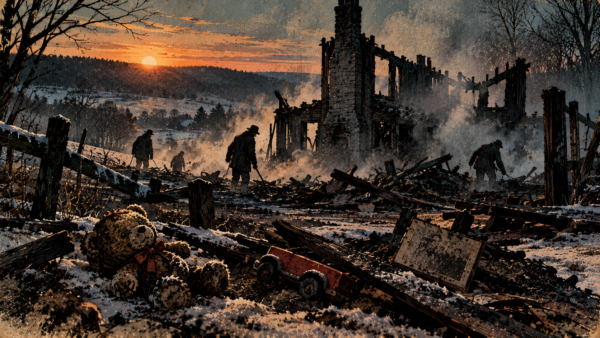
On Christmas night 1945 the Sodder family’s wooden house in Fayetteville burns down. George and Jennie Sodder get out with four of their children; five others are missing. The ladder George wanted to use to reach the first floor is not in its place, his trucks will not start, and the telephone line has been cut.
No identifiable human remains are found in the ashes. The parents believed until their deaths that the children had been taken before the fire; George had spoken out publicly against Mussolini and had been threatened. For decades a billboard with the children’s faces stood by the road.
Timeline
- After a loud bang on the roof at about 1 a.m., the house burns down.
- The state issues death certificates for the five children.
- A search at the site recovers bone fragments; an expert attributes them to a single person aged 16 to 22.
- After two hearings, the authorities close the case at state level.
- The family puts up a billboard with the children’s faces at the site.
- The family receives a photo in which they believe they recognise Louis as an adult.
- After the mother’s death, the billboard is taken down.
Status: Unsolved
Entry checked: 21 October 2026. AI-generated symbolic illustration.
 UnidentifiedIn-depth analysis
The Somerton Man
Read the in-depth analysis →Open case file: The Somerton Man
- Those affected
- Unknown man; identified in 2022 by researchers as Carl “Charles” Webb (b. 1905)
- Where found
- Somerton Beach, Adelaide, 1 December 1948
- Investigation status
- OpenCause of death unresolved; the identification has not yet been confirmed by police or forensic services
- Legal status
- According to reports, the coroner’s formal finding is still pending
- Open question
- How did he die, and what does the slip “Tamám Shud” mean?
On 1 December 1948 a dead man is found on Somerton Beach in Adelaide. The labels have been cut from his clothing and he carries no papers. In a hidden fob pocket is a scrap of paper with the words “Tamám Shud” (“It is finished”), torn from a copy of the Rubaiyat of Omar Khayyam. The cause of death stays unclear; doctors suspect poisoning.
For more than seventy years the man has no name. In 2022 the researcher Derek Abbott and the genealogist Colleen Fitzpatrick announce that DNA genealogy has identified him as Carl “Charles” Webb, an electrical engineer from Melbourne. Police and the coroner in South Australia have not officially confirmed that result.
Timeline
- The dead man is found on Somerton Beach.
- The case is investigated; the slip “Tamám Shud” turns up in a hidden pocket.
- The body is exhumed for new DNA analysis.
- Derek Abbott and Colleen Fitzpatrick name Carl Webb using genetic genealogy.
- According to the reports consulted, confirmation by police, forensic services and the coroner is still pending.
Status: Identity probably established, cause of death open
Entry checked: 21 October 2026. AI-generated symbolic illustration.
Sources: Smithsonian Magazine: 2022 identification · InDaily (27 Jul 2022) · Wikipedia: Somerton Man
 Cold case
The “Boy in the Box”
Open case file: The “Boy in the Box”
- Those affected
- Joseph Augustus Zarelli (about 4 years old), long known as “America’s Unknown Child”
- Where found
- Woods off Susquehanna Road in the Fox Chase district of Philadelphia, 25 February 1957; placed in a cardboard box
- Investigation status
- OpenIdentity established since December 2022; the killing remains an open homicide case
- Legal status
- No suspect charged
- Open question
- Who killed the boy?
On 25 February 1957 the body of a boy aged four to six is found in the Fox Chase district of Philadelphia: naked, malnourished, placed in a box that had originally held a baby’s cot. Despite a nationwide campaign with hundreds of thousands of flyers he stays nameless and is buried as “America’s Unknown Child”.
In December 2022 police identify him through genetic genealogy as Joseph Augustus Zarelli. Who killed him is still open.
Timeline
- The body is found in a box in the woods of Fox Chase.
- Police open an investigation and take the boy’s fingerprints.
- A newspaper prints 400,000 flyers; the boy is buried in a potter’s field.
- He is exhumed for a DNA sample and reburied.
- The National Center for Missing & Exploited Children releases a facial reconstruction.
- A second exhumation yields more DNA for genetic genealogy.
- Police name him as Joseph Augustus Zarelli.
- A new headstone with his name is unveiled.
Status: Identity established, killer unknown
Entry checked: 21 October 2026. AI-generated symbolic illustration.
 Cold caseIn-depth analysis
The Dyatlov Pass incident
Read the in-depth analysis →Open case file: The Dyatlov Pass incident
- Those affected
- Nine members of the ski hiking group led by Igor Dyatlov
- Where found
- Tent found on Kholat Syakhl (northern Urals) on 26 February 1959; the last bodies recovered on 4 May 1959
- Investigation status
- Closed, disputedSoviet inquiry: “a compelling natural force”; in 2020 Russian prosecutors named an avalanche as the cause; still disputed publicly
- Legal status
- No criminal proceedings; the investigation was closed in 1959 without a culprit
- Open question
- Why did the hikers leave their tent inadequately dressed, and does an avalanche explain all injuries?
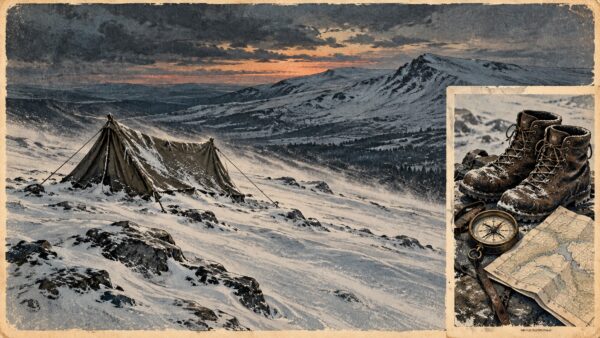
On the night of 2 February 1959 a group of nine ski hikers led by Igor Dyatlov leaves their tent on the slope of Kholat Syakhl. The tent has been cut open from the inside. Many of them are wearing only socks or nothing on their feet. Search parties find the bodies over several months: some froze to death, others have severe internal injuries such as skull and rib fractures without external wounds. One of the dead is missing her tongue, and traces of radioactivity are measured on clothing.
The Soviet authorities spoke of an “irresistible natural force”. In 2020 the Russian prosecutor general declared a slab avalanche to be the cause, and a 2021 study found that scenario physically plausible. Doubts and alternative theories persist all the same.
Timeline
- Yuri Yudin turns back because of illness, leaving nine hikers.
- The group leaves the tent on the slope of Kholat Syakhl.
- Search parties find the damaged, abandoned tent.
- The last four bodies are found under about four metres of snow.
- The inquiry ends without a culprit; the files go to a secret archive.
- Russian authorities reopen the investigation.
- An avalanche is announced as the official cause of death.
- A study (Gaume/Puzrin) finds a slab avalanche physically plausible; it is not an official finding.
Status: Officially classified as an avalanche, still debated
Entry checked: 21 October 2026. AI-generated symbolic illustration.
Sources: Wikipedia: Dyatlov Pass incident · In-depth analysis on the blog
 Cold caseIn-depth analysis
The Lake Bodom murders
Read the in-depth analysis →Open case file: The Lake Bodom murders
- Those affected
- Maila Björklund (15), Anja Mäki (15) and Seppo Boisman (18) killed; Nils Gustafsson (18) survived badly injured
- Where found
- Tent at Lake Bodom (Espoo), victims discovered on the morning of 5 June 1960
- Investigation status
- OpenOfficially unsolved; even after the 2005 acquittal the case is regarded as unsolved
- Legal status
- Nobody convicted; the only defendant was the survivor, acquitted in 2005 (compensated for pretrial detention by the Finnish state)
- Open question
- Who attacked the teenagers, and why?
In the early hours of 5 June 1960 four teenagers are asleep in a tent by Lake Bodom west of Helsinki. An unknown attacker strikes at them through the canvas with a blunt object and a knife. Maila Björklund (15), Anja Mäki (15) and Seppo Boisman (18) die; Nils Gustafsson (18) survives with severe injuries.
Over the decades various suspects are named, among them a local kiosk owner. In 2004 the survivor Gustafsson himself is unexpectedly charged; he is acquitted in 2005.
Timeline
- Four teenagers pitch their tent at Lake Bodom.
- The attack on the tent.
- A carpenter finds the victims and alerts the police.
- Survivor Nils Gustafsson is arrested after almost 44 years.
- The trial begins.
- Acquittal on all charges.
Status: Unsolved – Finland’s best-known murder case
Entry checked: 21 October 2026. AI-generated symbolic illustration.
Sources: Wikipedia: Lake Bodom murders · In-depth analysis on the blog
 Cold case
The Kennedy assassination
Open case file: The Kennedy assassination
- Those affected
- John F. Kennedy (46), President of the United States, killed; Governor John Connally wounded
- Where found
- Dealey Plaza, Dallas, 22 November 1963, about 12:30 p.m.; pronounced dead at 1:00 p.m.
- Investigation status
- Closed, disputedOfficially solved (Warren Commission 1964: Oswald as the lone gunman); in 1979 a House committee considered a conspiracy likely; disputed to this day
- Legal status
- Oswald died before any trial; the only trial over the crime (1969) ended in an acquittal; nobody was convicted
- Open question
- Did Oswald act alone, or was there a conspiracy?
On 22 November 1963 President John F. Kennedy is hit in the neck and head by gunfire while riding in an open limousine across Dealey Plaza in Dallas. In 1964 the Warren Commission concludes that Lee Harvey Oswald fired alone from the sixth floor of the school book depository. Oswald himself is shot by Jack Ruby two days after the assassination; there is never a trial.
In 1979 the House Select Committee called a conspiracy “likely”, based on an acoustic analysis that experts later rejected. The Zapruder film and the “magic bullet” remain the starting point for countless theories.
Timeline
- Shots hit Kennedy’s limousine on Dealey Plaza.
- Kennedy is pronounced dead at Parkland Hospital.
- Lee Harvey Oswald is arrested at the Texas Theatre.
- Jack Ruby shoots Oswald live on television at police headquarters.
- President Johnson establishes the Warren Commission.
- The Warren Commission presents its report: Oswald was the lone gunman.
- The House committee considers a conspiracy likely; its basis, an audio recording, is later debunked.
Status: Officially solved, disputed to this day
Entry checked: 21 October 2026. AI-generated symbolic illustration.
 MissingIn-depth analysis
The Beaumont Children
Read the in-depth analysis →Open case file: The Beaumont Children
- Those affected
- Jane (9), Arnna (7) and Grant Beaumont (4)
- Where found
- Last seen at Glenelg Beach, Adelaide, on 26 January 1966; never found
- Investigation status
- OpenUnsolved, the file remains open; the South Australian government has offered a A$1 million reward
- Legal status
- Nobody was charged or convicted
- Open question
- What happened to the children after their trip to the beach?
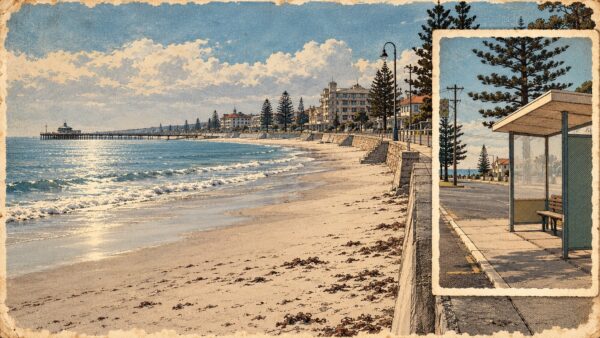
On 26 January 1966, Australia Day, the siblings Jane (9), Arnna (7) and Grant Beaumont (4) travel from Somerton Park to Glenelg Beach in Adelaide. They are expected home around lunchtime. When they do not return, their parents report them missing; one of the largest searches in South Australian history begins.
Witnesses believe they saw the children at the beach, possibly with an unknown man. No identification has ever been confirmed. Decades of searches, excavations and tips have produced neither remains nor a convicted offender.
Timeline
- The children take the bus from Somerton Park to Glenelg.
- They do not return as expected.
- The parents report them missing to the police.
- The Patawalonga Boat Haven is drained and searched; nothing is found.
- Letters supposedly from the children arrive; in 1992 they are identified as a hoax.
- A dig at North Plympton finds no evidence.
- A second dig at the same site is unrelated to the case.
- A privately funded dig finds no remains.
Status: Missing – Australia’s best-known missing-children case
Entry checked: 21 October 2026. AI-generated symbolic illustration.
Sources: Wikipedia: Beaumont children disappearance · In-depth analysis on the blog
 Cold case
The Zodiac Killer
Open case file: The Zodiac Killer
- Those affected
- Five confirmed murder victims and two survivors (Northern California, 1968–1969)
- Where found
- Crime scenes: Lake Herman Road (Benicia), Blue Rock Springs (Vallejo), Lake Berryessa and Presidio Heights (San Francisco)
- Investigation status
- OpenOpen; several agencies keep the case going, and the perpetrator has not been identified
- Legal status
- Nobody charged or convicted
- Open question
- Who was the Zodiac, and what lies hidden in the ciphers that remain unsolved?
Between 1968 and 1969 the Zodiac Killer demonstrably kills five people in northern California; two more survive with serious injuries. In letters to newspapers and police he claims many more victims, taunts the investigators and encloses ciphers.
The first cipher was cracked in 1969 by a married couple from Salinas; the so-called 340 cipher only fell in 2020, to an international team of amateur cryptologists. Neither gave away the killer. The best-known suspect, Arthur Leigh Allen, died in 1992 without ever being charged.
Timeline
- Lake Herman Road: the first confirmed double murder.
- Blue Rock Springs: a woman is killed and a man wounded.
- Letters containing parts of a cipher go to three newspapers.
- A couple from Salinas cracks the first cipher; it does not reveal the writer.
- Lake Berryessa: a couple is attacked, and the woman dies two days later.
- A taxi driver is shot in San Francisco.
- The last confirmed letter.
- San Francisco police first label the case inactive and reopen it in 2006.
- An international team decrypts the 340 cipher; the FBI verifies the solution, which gives no clue to the identity.
Status: Unsolved
Entry checked: 21 October 2026. AI-generated symbolic illustration.
Sources: Wikipedia: Zodiac Killer
 UnidentifiedIn-depth analysis
The Isdal Woman
Read the in-depth analysis →Open case file: The Isdal Woman
- Those affected
- Unknown woman (estimated born around 1930), travelled under at least eight identities
- Where found
- Isdalen near Bergen, 29 November 1970; partly burned body
- Investigation status
- OpenIdentity still unknown; police ruled it a suicide at the time, and the case was reopened in 2016
- Legal status
- No criminal proceedings; official classification at the time: suicide, others consider murder possible
- Open question
- Who was she, and did she die by her own hand or another’s?
On 29 November 1970 hikers find the partly burned body of a woman in the Isdalen valley near Bergen. Large quantities of sleeping pills are found in her body and the labels have been removed from her clothing. Two suitcases she had left at the railway station contain wigs, clothes without labels and a notebook with coded entries.
The investigation shows that she had travelled through Europe under at least eight false identities. Police closed the case as suicide at the time. Isotope analyses commissioned by the Norwegian broadcaster NRK in 2017 suggest she was born around 1930 and spent her childhood in the Nuremberg area. Theories range from suicide to Cold War espionage.
Timeline
- Last confirmed whereabouts: she checks out of the Hotel Hordaheimen in Bergen.
- Hikers find the partly burned body in Isdalen.
- Two suitcases with wigs, clothes without labels and a notebook turn up at Bergen station.
- Burial in an unmarked grave in Bergen.
- The case is reopened together with the broadcaster NRK.
- Isotope analysis of her teeth points to a childhood near Nuremberg or the French-German border area; sources differ here.
Status: Identity unexplained
Entry checked: 21 October 2026. AI-generated symbolic illustration.
Sources: Wikipedia: Isdal Woman · In-depth analysis on the blog
 Cold Case
D. B. Cooper
Open case file: D. B. Cooper
- Those affected
- A man who, under the name “Dan Cooper”, hijacked a Northwest Orient flight (Portland–Seattle); identity and whereabouts unknown
- Where found
- Tie with clip in seat 18-E; in 1980, $6,000 of the ransom turned up on the Columbia River
- Investigation status
- OpenThe FBI suspended the active investigation on 8 July 2016; the files are preserved, and no solution has been announced
- Legal status
- Nobody charged or convicted; in 1976 there was an indictment against “John Doe, a.k.a. Dan Cooper”
- Open question
- Who was “Dan Cooper”, and did he survive the jump?
On 24 November 1971, a man using the name Dan Cooper boarded a flight from Portland to Seattle. He demanded $200,000 and parachutes. Following another takeoff, he disappeared via the rear stairs. His identity and subsequent fate remain unresolved.
In 2016, the FBI announced that NORJAK resources would be redirected to other priorities. Evidence was to be preserved, and a reporting route remained for specific physical evidence. [2] This concerned investigative resources; it was not an announcement that the case had been solved.
Timeline
- The man hijacks a Boeing 727 and demands $200,000 and four parachutes.
- In flight the rear airstair opens; Cooper presumably jumps over southwestern Washington.
- Ground searches in the spring turn up nothing.
- A grand jury indicts “John Doe, a.k.a. Dan Cooper” in absentia.
- An eight-year-old boy finds bundles containing $6,000 of the ransom on the Columbia River.
- A partial DNA profile is obtained from the tie; it cannot be matched to anyone.
- The FBI ends the active investigation.
Status: Identity and fate unresolved
Entry checked: 19 October 2026. AI-generated symbolic illustration.
Sources: FBI · FBI Seattle · Wikipedia: D. B. Cooper
 Cold case
The Oklahoma Girl Scout murders
Open case file: The Oklahoma Girl Scout murders
- Those affected
- Lori Lee Farmer (8), Michele Heather Guse (9) and Doris Denise Milner (10)
- Where found
- Camp Scott, Mayes County, Oklahoma; the bodies were found on 13 June 1977 at about 6 a.m., some 150 yards from the tent
- Investigation status
- OpenLegally unresolved; a sheriff said in 2022 that new DNA results point to the former defendant, but a court ruling is no longer possible
- Legal status
- The only defendant was acquitted in 1979 and died in custody the same year; nobody convicted
- Open question
- How reliable are the DNA results announced in 2022?
On the night of 13 June 1977 three girls, Lori Lee Farmer (8), Michele Guse (9) and Doris Denise Milner (10), are dragged from their tent at the Camp Scott Girl Scout camp, assaulted and killed. Their bodies are found near the tent the next morning.
Police arrest the escaped prisoner Gene Leroy Hart. A jury acquits him in 1979; a few months later he dies in prison, where he was serving an earlier sentence. In 2022 the county sheriff stated that new DNA testing pointed to Hart; the question can no longer be settled in court.
Timeline
- The three girls move into tent 7 on the eve of the start of camp.
- A counselor spots a sleeping bag in the woods; the three girls are dead.
- A man who had escaped from jail is arrested.
- A jury unanimously acquits the defendant.
- He dies in prison of a heart attack.
- DNA tests cannot rule him out but do not identify him conclusively.
- The sheriff says new DNA results strongly point to the former defendant.
Status: Legally unresolved
Entry checked: 21 October 2026. AI-generated symbolic illustration.
 Disappearance
The Yuba County Five
Open case file: The Yuba County Five
- Those affected
- Gary Mathias, Ted Weiher, Jack Madruga, Bill Sterling and Jackie Huett
- Where found
- Car found on 28 February 1978 stuck in snow on a mountain road in Plumas National Forest; remains of four men in June 1978
- Investigation status
- OpenSequence of events unexplained; officially, hypothermia or starvation is established for two of the dead, the other circumstances remain open
- Legal status
- Nobody charged or convicted
- Open question
- How did the men reach the find site, and where is Gary Mathias?
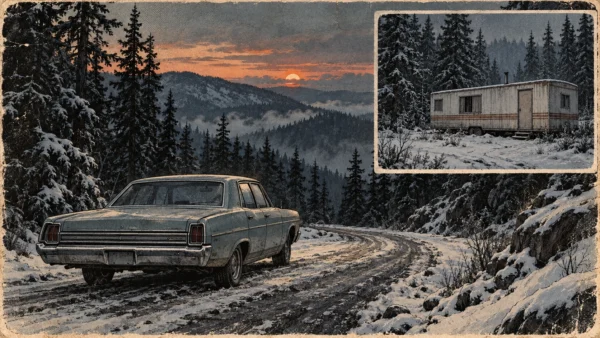
Gary Mathias, Ted Weiher, Jack Madruga, Bill Sterling and Jackie Huett attended a basketball game in Chico on 24 February 1978. They did not return home. Their car was later found on a snowy mountain road away from the expected route. Four men’s remains were found in June. Mathias remains missing.
The recovery sites document a catastrophe; they do not provide a complete shared route. Disorientation, an accident or an external threat each require evidence. None becomes certain simply because later observers find the decisions incomprehensible.
Timeline
- The five men attend a basketball game in Chico and do not come home.
- A ranger leads deputies to the unlocked car stuck in the snow.
- Motorcyclists find a Forest Service trailer with Ted Weiher inside.
- Remains of Jack Madruga, Bill Sterling and Jackie Huett are found nearby.
- Gary Mathias has never been found; his shoes were in the trailer.
Status: Four found dead; Gary Mathias missing; sequence unresolved
Entry checked: 19 October 2026. AI-generated symbolic illustration.
Sources: Solve the Case · Wikipedia: Yuba County Five
 Cold case
The murder on the Viking Sally
Open case file: The murder on the Viking Sally
- Those affected
- Klaus Schelkle (20, killed) and Bettina Taxis (22, seriously injured, survived)
- Where found
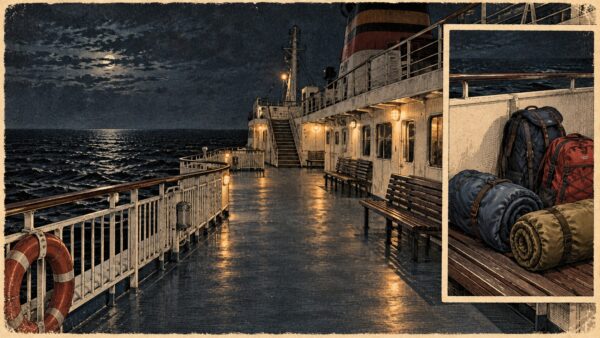
- Helipad deck (9th deck, aft) of the ferry Viking Sally, Stockholm–Turku; found at about 3:45 a.m. on 28 July 1987
- Investigation status
- OpenUnsolved; the 2021 acquittal stands, and prosecutors withdrew their appeal in 2022
- Legal status
- In 2020 a person who had been a Danish boy scout at the time was charged; in June 2021 the Southwestern Finland District Court acquitted them
- Open question
- Who attacked the two?
On the night of 28 July 1987 Klaus Schelkle (20) and Bettina Taxis (22) from Baden-Württemberg are sleeping in sleeping bags on the helicopter deck of the ferry Viking Sally between Stockholm and Turku. At about 3.45 a.m. they are found badly injured. Klaus Schelkle dies; Bettina Taxis survives with no memory of the attack. The weapon was never found.
They were found by a group of Danish scouts. One of them was charged in 2020 after allegedly confessing years later; a Finnish court acquitted him in 2021. The ship sank in 1994 under the name Estonia.
Timeline
- The couple sail from Stockholm to Turku with a friend, without a cabin.
- The two fetch their sleeping bags and go to the helipad deck.
- Danish boy scouts find them seriously injured.
- A helicopter takes both to Turku hospital; Klaus Schelkle is dead on arrival.
- The investigation is discontinued.
- Police declare the case solved; charges follow shortly after.
- The trial begins; the acquittal follows in June 2021.
- Prosecutors withdraw their appeal.
Status: Unsolved
Entry checked: 21 October 2026. AI-generated symbolic illustration.
Sources: Wikipedia: 1987 Viking Sally murder
 Cold case
The death of Uwe Barschel
Open case file: The death of Uwe Barschel
- Those affected
- Uwe Barschel (43), former Minister-President of Schleswig-Holstein
- Where found
- Room 317 of the Hotel Beau-Rivage, Geneva, found dead in the bathtub on 11 October 1987 at 12:43 p.m.
- Investigation status
- Closed, disputedOfficially suicide is rated as likely; many publications doubt this, and the Lübeck investigation was closed
- Legal status
- Investigation against persons unknown on suspicion of murder (Lübeck, from 1993/94) concluded in 1998; nobody charged
- Open question
- Suicide or killing?
On 11 October 1987 a reporter for the magazine “Stern” finds Uwe Barschel, the former minister-president of Schleswig-Holstein, dead and fully dressed in the bathtub of room 317 at the Hotel Beau-Rivage in Geneva. Nine days earlier Barschel had resigned over the Kiel affair, in which his challenger Björn Engholm was spied on – with the words “I give you my word of honour”.
The cause of death is poisoning with several sleeping pills and sedatives, including cyclobarbital. The Geneva authorities assumed suicide. From 1994 the Lübeck public prosecutor investigated on suspicion of murder, but closed the case in 1998 without settling the question. Theories about arms deals and intelligence services have never been substantiated.
Timeline
- Der Spiegel reports on a smear campaign against Barschel’s challenger (the Kiel affair).
- Press conference: Barschel gives his “word of honour”.
- Barschel resigns as Minister-President.
- A reporter finds him dead in room 317 of the Geneva hotel.
- The Lübeck prosecutor’s office opens an investigation against persons unknown on suspicion of murder.
- The investigation is concluded (overall report of 27 April 1998).
- A report by the state prosecutor general rates suicide as likely.
- Reports of DNA traces from another person; the prosecutor’s office sees no sufficient grounds for further steps.
Status: Suicide or murder unresolved
Entry checked: 21 October 2026. AI-generated symbolic illustration.
Sources: Wikipedia (German): Uwe Barschel
 Cold case
Sonja Engelbrecht
Open case file: Sonja Engelbrecht
- Those affected
- Sonja Engelbrecht (19)
- Where found
- Last seen at Stiglmaierplatz in Munich, 11 April 1995; skeletal remains in a rock crevice near Kipfenberg (Eichstätt district), found in 2020 and 2022
- Investigation status
- OpenHomicide, perpetrator unknown; the investigation continues
- Legal status
- No suspect charged
- Open question
- Who killed Sonja Engelbrecht and brought her to Kipfenberg?
On the night of 11 April 1995 the 19-year-old Sonja Engelbrecht parts from an acquaintance at Stiglmaierplatz in Munich to make a call from a phone box. After that her trail goes cold.
In the summer of 2020 a forestry worker near Kipfenberg in the Eichstätt district, about 100 kilometres north of Munich, finds a thigh bone in a rock crevice. During a large search in 2022 more bones, wrapped in plastic film, are recovered. Police assume a violent crime committed by someone who knew the area.
Timeline
- Last confirmed time at Stiglmaierplatz: her companion boards a tram, Sonja stays behind alone.
- Her parents report her missing; soon after, the homicide division takes over.
- The case is featured in “Aktenzeichen XY … ungelöst”.
- A forestry worker finds a thigh bone near Kipfenberg; DNA analysis attributes it to Sonja.
- In a large search, further skeletal remains are found about 200 metres away in a rock crevice.
- Another XY broadcast shows finds, including remnants of a blanket; more than 50 calls come in.
Status: Violent crime, perpetrator unknown
Entry checked: 21 October 2026. AI-generated symbolic illustration.
 UnidentifiedIn-depth analysis
The Plaza Woman (“Jennifer Fairgate”)
Read the in-depth analysis →Open case file: The Plaza Woman (“Jennifer Fairgate”)
- Those affected
- Unidentified woman; checked in as “Jennifer Fairgate” (spelled “Fergate” on the forms) with a false address in Belgium
- Where found
- Room 2805, Oslo Plaza Hotel, 3 June 1995
- Investigation status
- Closed, disputedPolice: suicide, case officially closed; critics question the ruling, and her identity is still unknown
- Legal status
- No criminal proceedings
- Open question
- Who was she, and was it suicide or third-party involvement?
In late May 1995 a woman checks into the Oslo Plaza as “Jennifer Fergate”, giving a Belgian address that does not exist. On 3 June the hotel wants to settle the unpaid bill. As staff knock on the door of room 2805, a shot is fired. The woman is lying dead on the bed with a pistol in her hand; the door was locked from the inside.
Police closed the case as suicide. Critics point to the inconsistencies: the grip on the weapon, the missing papers, the clothing without labels. DNA and isotope analyses commissioned by Norwegian media in 2017 point to an origin in central Europe. Who she was is still unknown.
Timeline
- The woman checks in under a false name and address and takes room 2805.
- A security guard knocks and hears a gunshot; the woman is found dead on the bed, the door double-locked from inside.
- Police rule it a suicide: a pistol was in her hand, she had no ID, and the labels had been removed from her clothes.
- Burial in an unmarked pauper’s grave in Oslo.
- The remains are exhumed for DNA, isotope and radiocarbon analysis, which point to a childhood in Germany and a birth year around 1971.
- The case features in the Netflix series “Unsolved Mysteries”.
Status: Identity unexplained
Entry checked: 21 October 2026. AI-generated symbolic illustration.
Sources: Wikipedia: Jennifer Fairgate case · In-depth analysis on the blog
 MissingIn-depth analysis
Amy Lynn Bradley
Read the in-depth analysis →Open case file: Amy Lynn Bradley
- Those affected
- Amy Lynn Bradley (23)
- Where found
- Last seen aboard the Rhapsody of the Seas (Royal Caribbean) shortly before Curaçao, 24 March 1998; never found
- Investigation status
- OpenUnsolved; the FBI and the family have offered rewards for information
- Legal status
- Legally declared dead in 2010 (without a body); nobody charged in connection with the disappearance
- Open question
- Fall overboard, abduction or something else? None of the sightings has been confirmed.
Early on 24 March 1998 the 23-year-old Amy Lynn Bradley disappears from the Rhapsody of the Seas, shortly before the ship docks in Curaçao. Her father had seen her asleep on the balcony of the family cabin at about 5.15 a.m.; minutes later she was gone.
A search on board and at sea finds nothing. In the years that follow there are several reported sightings in the Caribbean, among them the account of a US sailor who says he met her in a brothel. None of them has been confirmed.
Timeline
- The family boards the Rhapsody of the Seas.
- The key card system logs Amy’s return to the family cabin.
- Her father sees her asleep on the balcony.
- He finds her gone; the family soon reports her missing to the crew.
- The Dutch Caribbean Coast Guard searches for four days without success.
- Several sightings (Curaçao, Barbados and others); none is confirmed.
- Amy is legally declared dead after twelve years.
- The Netflix documentary “Amy Bradley Is Missing” is released.
Status: Missing
Entry checked: 21 October 2026. AI-generated symbolic illustration.
Sources: Wikipedia: Disappearance of Amy Bradley · In-depth analysis on the blog
 Cold case
Peggy Knobloch
Open case file: Peggy Knobloch
- Those affected
- Peggy Knobloch (9)
- Where found
- Last seen after 1 p.m. in Lichtenberg, 7 May 2001; skeletal remains found on 2 July 2016 in a forest near Rodacherbrunn (Thuringia)
- Investigation status
- ClosedInvestigation closed on 22 October 2020; the killing remains unsolved, and murder has no statute of limitations
- Legal status
- The man convicted in 2004 was finally acquitted in 2014 in a retrial; currently nobody is convicted
- Open question
- Who killed Peggy, and how did she get to the find site?
On 7 May 2001 nine-year-old Peggy Knobloch disappears in Lichtenberg on her way home from school. In 2004 Ulvi K., a man with an intellectual disability, is convicted of murder on the basis of a confession he later withdrew; in 2014 a retrial acquits him.
On 2 July 2016 a mushroom picker finds parts of the girl’s skeleton in a forest in Thuringia, about 15 kilometres from Lichtenberg. A DNA trace of the NSU terrorist Uwe Böhnhardt at the site turns out to be contamination from a forensic tool. In 2018 a man admits having taken the body there but denies killing the child; the proceedings were closed in 2020.
Timeline
- Peggy disappears on her way home from school.
- A man is arrested and confesses, later retracting the confession.
- The Hof regional court sentences him to life imprisonment; the confession is the main evidence.
- In a retrial he is acquitted.
- A mushroom picker finds skeletal remains near Rodacherbrunn; DNA analysis identifies them as Peggy’s.
- A DNA trace of a right-wing terrorist is found at the site, which prosecutors classify in 2017 as a false trace.
- Another man is arrested; the arrest warrant is lifted after about two weeks.
- Prosecutors close the investigation.
Status: Killing unexplained, investigation closed in 2020
Entry checked: 21 October 2026. AI-generated symbolic illustration.
Sources: Wikipedia (German): Peggy Knobloch
 Missing
Maura Murray
Open case file: Maura Murray
- Those affected
- Maura Murray (21), nursing student at UMass Amherst
- Where found
- Last seen on Route 112 near Haverhill, New Hampshire, on 9 February 2004; her car was found abandoned
- Investigation status
- OpenOpen; New Hampshire’s cold case unit treats it as a suspicious missing-persons case
- Legal status
- Nobody has been charged in connection with the disappearance
- Open question
- Accident in the woods, crime or voluntary disappearance?
On the evening of 9 February 2004 the 21-year-old student Maura Murray runs her car off Route 112 in New Hampshire. A bus driver offers help; she declines and asks him not to call the police. When officers arrive a few minutes later, she is gone.
Before the drive she had emailed her professors about a death in the family that had not happened, and had withdrawn almost all of her money. The hypotheses range from dying of exposure in the woods to a crime to disappearing on purpose.
Timeline
- Maura leaves the Amherst campus in her car; earlier she withdrew $280.
- Her car hits a snowbank on Route 112; a bus driver stops, she declines help and asks him not to call the police.
- Police arrive: the car is locked, the airbags have deployed, and Maura is gone.
- The FBI joins the investigation; several searches with dogs and a helicopter find nothing.
- A relatives’ initiative offers a $75,000 reward.
- The case is assigned to New Hampshire’s newly created cold case unit.
- The FBI issues a national alert.
- An age-progression photo is released on the 20th anniversary.
Status: Missing
Entry checked: 21 October 2026. AI-generated symbolic illustration.
 Missing
Brian Shaffer
Open case file: Brian Shaffer
- Those affected
- Brian Shaffer (27), medical student at Ohio State University
- Where found
- Last seen in and outside the bar “Ugly Tuna Saloona”, High Street, Columbus, on 1 April 2006 at about 1:55 a.m.; no footage of him leaving the bar
- Investigation status
- OpenMissing; the case is open, and police still receive occasional tips
- Legal status
- No charges known
- Open question
- How did he leave the bar, and what happened afterwards?
On the night of 1 April 2006 the 27-year-old medical student Brian Shaffer is out with friends at the Ugly Tuna Saloona bar in Columbus. Security cameras record him going in and talking outside the entrance at about 1.55 a.m.
There is no recording of him leaving. An exit through building works inside, however, lay outside the cameras’ range. Despite an intensive search he remains missing; the hypotheses range from an accident to a crime to a deliberate disappearance.
Timeline
- Brian meets a friend at the bar “Ugly Tuna Saloona”.
- Security cameras show the group on the escalator to the main entrance.
- A camera shows him outside the bar talking to two young women; then he leaves the frame.
- He misses a flight to Miami and is reported missing to the police.
- His phone rings three times; a ping points to a cell tower in Hilliard, and the carrier blames a glitch.
- Police still get about two tips a month, none useful.
- An age-progressed image shows him at 42.
Status: Missing
Entry checked: 21 October 2026. AI-generated symbolic illustration.
 Cold caseIn-depth analysis
Frauke Liebs
Read the in-depth analysis →Open case file: Frauke Liebs
- Those affected
- Frauke Liebs (21), nursing student from Paderborn
- Where found
- Body found on 4 October 2006 in woodland near Lichtenau; the find site was probably not the crime scene
- Investigation status
- OpenMurder unsolved; the investigation continues because murder has no statute of limitations
- Legal status
- No suspect charged or convicted
- Open question
- Who held her, and why did she phone for more than a week?
On the night after a World Cup match in June 2006 the 21-year-old nursing student Frauke Liebs disappears in Paderborn on her way home from a pub.
Over the following days she contacts her flatmate and her sister several times by mobile phone, mostly in the evening and only briefly, saying things like she would be home soon. The cell sites are in and around Paderborn. Investigators believe she was making the calls under duress. On 4 October 2006 a hunter finds her body in woodland near Lichtenau. The killer is still unknown.
Timeline
- Frauke leaves a pub in Paderborn and probably walks home.
- Her roommate receives a text from her phone, sent from the Nieheim-Entrup area.
- Several short calls to her roommate and family; the last call on 27 June lasts more than five minutes.
- A hunter finds the body near Lichtenau.
- The special commission is dissolved; the investigation continues.
- The reward is raised to €30,000.
- Searches of two houses in Lichtenau and Paderborn produce no new leads.
Status: Murder unsolved
Entry checked: 21 October 2026. AI-generated symbolic illustration.
Sources: Wikipedia (German): Frauke Liebs · In-depth analysis on the blog
 Missing
Madeleine McCann
Open case file: Madeleine McCann
- Those affected
- Madeleine McCann (3, almost four years old)
- Where found
- Last seen in apartment 5A of the Ocean Club resort, Praia da Luz (Algarve), on 3 May 2007; reported missing at about 10 p.m.
- Investigation status
- OpenOpen; the Portuguese investigation was archived in 2008 and reopened in 2013, and German authorities have been investigating since 2020
- Legal status
- Nobody charged; German prosecutors are investigating a man convicted of other offences
- Open question
- What happened to Madeleine?
On the evening of 3 May 2007 Madeleine McCann, almost four, disappears from an apartment in the Ocean Club holiday complex in Praia da Luz. Her parents are eating with friends at a tapas bar nearby and take turns checking on the children. At about 10 p.m. Madeleine’s bed is empty.
Portuguese police treated the parents as suspects for a time but closed that line in 2008. Since 2020 German investigators have named as their main suspect a German man convicted of other offences who lived on the Algarve in 2007; he denies any involvement and was released from prison in September 2025. Nobody has been charged.
Timeline
- The parents dine with friends at the resort’s tapas restaurant while the children sleep in the apartment.
- Kate McCann finds Madeleine’s bed empty and raises the alarm.
- The parents are named arguidos (suspects) in Portugal.
- The Portuguese Attorney General archives the case for lack of evidence against the parents.
- Scotland Yard launches Operation Grange.
- Portuguese police reopen their inquiry.
- German investigators name a man imprisoned in Germany and convicted of other offences as a suspect; no charges have been brought.
Status: Missing, investigation ongoing
Entry checked: 21 October 2026. AI-generated symbolic illustration.
 Missing
Brandon Swanson
Open case file: Brandon Swanson
- Those affected
- Brandon Swanson (19), student
- Where found
- Last heard in a phone call with his father in the night of 14 May 2008; his car was stuck in a ditch near Taunton, Minnesota
- Investigation status
- OpenMissing; Minnesota’s Bureau of Criminal Apprehension has led the search since 2010, and by 2015 about 122 square miles had been searched
- Legal status
- No charges, no suspect known
- Open question
- Accident at the Yellow Medicine River, voluntary disappearance or foul play?
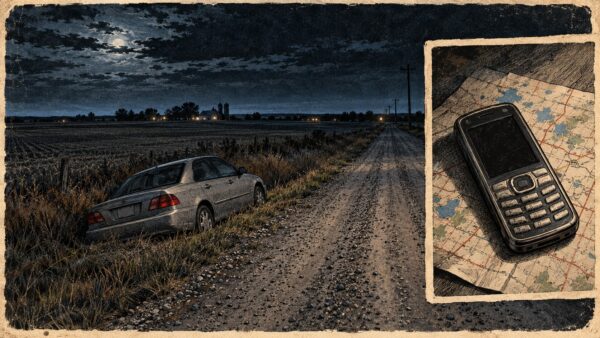
On the night of 14 May 2008 the 19-year-old Brandon Swanson is driving home from a party when his car slides into a ditch on a field track. At 1.54 a.m. he calls his parents; he thinks he is near Lynd. They cannot find him there.
Brandon walks across country towards some lights, staying on the phone with his father for about 47 minutes. Then he says “Oh shit!” and the line goes dead. His car was in fact near Taunton, far from Lynd. An accident at the Yellow Medicine River is suspected; he was never found.
Timeline
- The semester ends; Brandon celebrates in Canby and drives home before midnight.
- He calls his parents: his car is stuck in a ditch, and he plans to walk toward lights.
- After about 47 minutes on the phone he says “Oh shit!”, and the line goes dead.
- His parents report him missing; his car is later found almost 25 miles from Lynd.
- Tracking dogs follow a scent trail to the Yellow Medicine River.
- “Brandon’s Law” takes effect: police must act promptly in missing-adult cases.
- The state Bureau of Criminal Apprehension takes over and sets up a tip line.
Status: Missing
Entry checked: 21 October 2026. AI-generated symbolic illustration.
 Unidentified
“Peter Bergmann”
Open case file: “Peter Bergmann”
- Those affected
- Unknown man who checked in under the name “Peter Bergmann” (“Bergman” in some records)
- Where found
- Beach at Rosses Point near Sligo, Ireland, 16 June 2009
- Investigation status
- OpenIdentity unresolved; the case stays open until the man is identified (renewed police appeal in October 2021)
- Legal status
- No foul play; no criminal proceedings
- Open question
- Who was he, and why did he erase his traces?
On 12 June 2009 an older man with a German or Austrian accent travels to Sligo and checks in as “Peter Bergmann”, giving a Vienna address that does not exist. Over the following days he leaves the hotel several times with a purple plastic bag and returns without it; cameras show him getting rid of his things piece by piece.
On 16 June he is found dead on the beach at Rosses Point. The labels have been removed from his clothing. The autopsy finds advanced prostate cancer with metastases and no classic drowning; heart failure is named as the cause of death. Who he was is unknown.
Timeline
- He checks in at the Sligo City Hotel, pays cash and gives a Vienna address that does not exist.
- Surveillance cameras show him several times in and around Sligo.
- His body is found on the beach at Rosses Point; the labels are missing from his clothing.
- Autopsy: advanced cancer, heart failure as the cause of death.
- Burial in an unmarked grave in Sligo; six people attend.
- The autopsy findings become public at the inquest.
- Irish police renew their appeal for identification.
Status: Identity unexplained
Entry checked: 21 October 2026. AI-generated symbolic illustration.
Sources: Garda Síochána: Renewed appeal (31 Oct 2021) · Irish Times: The unsolved mystery of Peter Bergmann
 Cold case
Phoebe Handsjuk
Open case file: Phoebe Handsjuk
- Those affected
- Phoebe Handsjuk (24)
- Where found
- Garbage room of an apartment building in Melbourne, 2 December 2010; fell twelve storeys down the garbage chute
- Investigation status
- Closed, disputedCoroner (inquest December 2014): neither suicide nor foul play, an accident; the family disputes this
- Legal status
- No criminal proceedings
- Open question
- How did Phoebe get into the garbage chute?
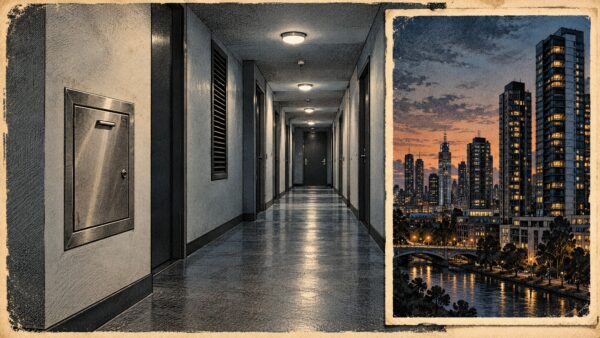
On 2 December 2010 the 24-year-old Phoebe Handsjuk is found in the garbage room of an apartment building in Melbourne. She had fallen twelve floors down the narrow rubbish chute and was severely injured in the compactor; she bled to death.
In 2014 the coroner concluded that she had climbed into the chute herself under the influence of alcohol and the sleeping drug zolpidem – an accident. Her family and several experts consider that barely conceivable and are still calling for a fresh investigation.
Timeline
- Phoebe Handsjuk is found in the building’s garbage room.
- The family collects its own evidence and submits it to the coroner.
- After a 14-day inquest, the coroner rules out suicide and foul play and treats the death as an accident under the influence of alcohol and the sleeping drug zolpidem.
- Media reports question the ruling.
- The family continues to demand new investigations.
Status: Officially an accident, doubted by the family
Entry checked: 21 October 2026. AI-generated symbolic illustration.
Sources: Wikipedia: Phoebe Handsjuk · Robin Bowles: Into the Darkness (Scribe)
 Cold caseIn-depth analysis
Elisa Lam
Read the in-depth analysis →Open case file: Elisa Lam
- Those affected
- Elisa Lam (21), Canadian student
- Where found
- Body found in a rooftop water tank at the Cecil Hotel, 19 February 2013
- Investigation status
- ClosedCoroner: accidental drowning; according to media reports the police have closed the case
- Legal status
- No criminal proceedings known
- Open question
- How did she reach the roof and the tank?
The 21-year-old Canadian student Elisa Lam is travelling alone through California in early 2013 and staying at the Cecil Hotel in Los Angeles. She is last seen on 31 January. Police release a lift video in which she presses all the buttons, peers into the corridor and gestures strangely.
On 19 February, after complaints about the tap water, a caretaker finds her body in one of the water tanks on the roof; the hatch was open. The coroner recorded accidental drowning, with bipolar disorder a significant factor. How she got onto the roof and into the tank still occupies online investigators.
Timeline
- Elisa Lam is last seen.
- Police release the elevator video.
- A maintenance worker finds the body after complaints about low water pressure.
- Water samples show no harmful bacteria; a do-not-drink order stays in place as a precaution.
- The final report rules the death an accidental drowning, with bipolar disorder as a significant condition.
Status: Officially an accident, frequently doubted
Entry checked: 21 October 2026. AI-generated symbolic illustration.
Sources: NBC News: water tests (22 Feb 2013) · NBC Los Angeles: ruling · Wikipedia: Death of Elisa Lam
 Missing
Kris Kremers and Lisanne Froon
Open case file: Kris Kremers and Lisanne Froon
- Those affected
- Kris Kremers (21) and Lisanne Froon (22), students from Amersfoort
- Where found
- Backpack found on 11 June 2014 in the Río Culebra near Alto Romero; remains found between June and August 2014 in the same river area
- Investigation status
- Closed, disputedPanamanian public prosecutor: accidental fall into a river, investigation formally closed on 24 September 2014; the result is disputed by other researchers and journalists
- Legal status
- No third-party involvement established (Panamanian public prosecutor)
- Open question
- Accident or crime? What happened after 1 April?
On 1 April 2014 the students Kris Kremers (21) and Lisanne Froon (22) set out from Boquete for a walk on the Pianista Trail. They do not come back. Over the following days their phones try again and again to reach the emergency numbers 112 and 911 – with no reception.
About ten weeks later their backpack is found on a riverbank, holding the phones, money and a camera with some 90 photographs taken during the night of 8 April. Shortly afterwards bones and a foot in a hiking boot are discovered. The Panamanian authorities assume an accident; others consider a crime possible. Annette Nenner and I have set out the evidence and the open questions in the book “Still Lost in Panama” and on the forensics page.
Timeline
- Kris and Lisanne set out on a hike on the Pianista Trail.
- Tour guide Feliciano González searches for them and turns back on the trail.
- The camera records about 90 photos during the night.
- Lisanne’s backpack is found in the Río Culebra.
- First bone finds and Lisanne’s shoe with foot on the riverbank.
- The public prosecutor formally closes the investigation: accidental fall into a river.
Status: Authorities: an accident – disputed to this day
Entry checked: 21 October 2026. AI-generated symbolic illustration.
Sources: Case lexicon Kris Kremers & Lisanne Froon · Still Lost in Panama (Hardinghaus/Nenner), analysis of the investigation files
 Missing
Lars Mittank
Open case file: Lars Mittank
- Those affected
- Lars Mittank (28)
- Where found
- Last seen at Varna airport (Bulgaria), 8 July 2014: cameras show him climbing a fence and running toward a forest
- Investigation status
- OpenMissing; his fate is unresolved, and private investigations and hospital checks produced no result
- Legal status
- No criminal proceedings known
- Open question
- Acute crisis or real threat, and where did he run?
On 8 July 2014 the 28-year-old Lars Mittank is due to fly home after a holiday on the Golden Sands near Varna. He has an ear injury from a fight a few days earlier, and an airport doctor advises him not to fly.
When a man enters the treatment room, Lars panics and runs off without his luggage. Security cameras show him crossing the grounds, climbing a fence and disappearing towards a field. He had told his mother on the phone that he felt he was being followed. Whether an acute mental health crisis or a real threat lay behind it is open.
Timeline
- Lars travels with five friends to Golden Sands near Varna.
- After a dispute in a bar he reports injuries; a doctor advises against flying.
- His friends fly home as planned.
- At the airport he flees the treatment room, leaving his wallet, phone and passport; cameras film him running.
- A truck driver believes he saw him hitchhiking in Varna; the sighting is unconfirmed.
- Another truck driver reports a similar hitchhiker in Brandenburg; this lead is also unconfirmed.
Status: Missing
Entry checked: 21 October 2026. AI-generated symbolic illustration.
Sources: Wikipedia: Lars Mittank
 Cold case
Magdalena Żuk
Open case file: Magdalena Żuk
- Those affected
- Magdalena Żuk (27), beautician from Poland
- Where found
- Holiday resort Marsa Alam, Egypt; fell from a window of a clinic in Port Ghalib, died on 30 April 2017 in a second hospital
- Investigation status
- Closed, disputedEgyptian authorities: suicide in connection with an acute mental health crisis; Polish prosecutors first investigated on suspicion of murder, and the results of the Polish autopsy were not published in detail
- Legal status
- No criminal proceedings known; Egypt found no evidence of third-party involvement
- Open question
- What triggered the sudden mental health crisis?
In April 2017 the 27-year-old Magdalena Żuk flies alone to Marsa Alam; her boyfriend cannot travel because of a passport problem. Within a short time her behaviour changes markedly: she seems frightened and confused, and a video call with her boyfriend shows her in distress.
She is taken to a hospital in Port Ghalib, where she falls from a window and dies shortly afterwards. Egyptian and Polish authorities assume suicide during an acute psychosis. Theories about drugs, abuse or human trafficking have not been substantiated.
Timeline
- Magdalena flies alone to Marsa Alam for a week-long holiday.
- Her behaviour changes sharply; she appears confused and frightened.
- She is taken to a clinic, falls from a window and dies a few hours later in hospital.
- Egypt’s Forensic Authority begins the autopsy, with a Polish investigator present.
- Polish prosecutors say they are investigating on suspicion of murder; other scenarios are a nervous breakdown or human trafficking.
- The Egyptian autopsy names the fall as the cause of death and rules the case a suicide; a second autopsy in Poland is not published in detail.
Status: Officially suicide, disputed
Entry checked: 21 October 2026. AI-generated symbolic illustration.
Sources: AP/CBS News: Polish woman’s death remains mystery (16 May 2017) · Egyptian Streets: Autopsy (11 May 2017) · Crime + Investigation: What really happened to Magdalena Żuk
 Missing
Rebecca Reusch
Open case file: Rebecca Reusch
- Those affected
- Rebecca Reusch (15)
- Where found
- Last at her sister’s home in Berlin-Britz, 18 February 2019; last Wi-Fi login of her phone at about 7:46 a.m.
- Investigation status
- OpenOpen; investigators assume a homicide, but there is no proof so far; further searches took place in October 2025
- Legal status
- Nobody charged; one suspect was arrested twice in 2019 and released for lack of evidence
- Open question
- What happened on the morning of 18 February 2019, and where is Rebecca?
On the morning of 18 February 2019 the 15-year-old Rebecca Reusch disappears from her sister’s house in Berlin-Britz, where she had spent the night. She never arrives at school. Investigators believe she did not leave the house alive.
The focus is on her brother-in-law, who was in the house with her that morning. The family car was recorded by automatic number plate recognition on the A12 motorway towards Frankfurt (Oder) on 18 and 19 February. He was arrested twice and released, and denies any involvement; he has not been charged. In October 2025 police again searched properties in Brandenburg. Rebecca has not been found.
Timeline
- Rebecca stays overnight at her sister’s home in Berlin-Britz.
- Her sister leaves the house with her daughter.
- The last Wi-Fi login of her phone.
- Licence-plate recognition registers a family vehicle on the A12 toward Frankfurt (Oder).
- A suspect is arrested twice and released shortly after each time.
- The case is shown on “Aktenzeichen XY … ungelöst”; more than 300 tips come in.
- Forests and lakes along the A12 are searched without relevant findings.
- More than 100 officers search a property in Brandenburg.
Status: Missing
Entry checked: 21 October 2026. AI-generated symbolic illustration.
Sources: Wikipedia (German): Rebecca Reusch
 Cold Case
The Setagaya Murders
Open case file: The Setagaya Murders
- Those affected
- A family of four: the parents and two children (aged 8 and 6)
- Where found
- Family home in Kami-soshigaya, Setagaya, Tokyo; discovered on 31 December 2000
- Investigation status
- OpenUnsolved; Tokyo police keep the case open with a public appeal and a ¥20 million reward (as of December 2021)
- Legal status
- Perpetrator unknown, nobody charged; the statute of limitations for such crimes was abolished in 2010
- Open question
- Who was the perpetrator, and why did he stay in the house for hours?
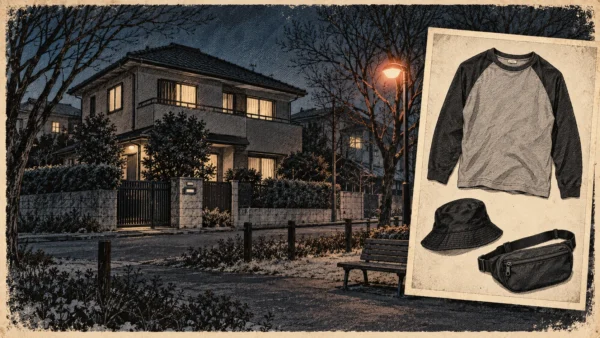
A family of four was killed in Kami-soshigaya, in Tokyo’s Setagaya ward, during the night of 30–31 December 2000. The police continue to document the case through a public appeal.
The number of recovered objects is only one consideration. Each trace needs a reliable connection to a person and an account of how it arrived. More material can create more opportunities for testing, while also raising questions about context.
Timeline
- The family is killed during the night; police estimate the time at about 11:30 p.m. to 12:05 a.m.
- The wife’s mother discovers the bodies.
- Japan abolishes the statute of limitations for crimes punishable by death.
- Police have a 3D model of the house made.
- Police announce the house will be demolished for safety reasons; evidence from the interior has been preserved.
- Another public appeal for information; the reward is ¥20 million.
Status: Unsolved quadruple murder
Entry checked: 19 October 2026. AI-generated symbolic illustration.
Sources: Tokyo Metropolitan Police Department · Tokyo Metropolitan Police Department · Tokyo Metropolitan Police Department · Wikipedia: Setagaya family murder
 Disappearance
The Flannan Isles Lighthouse Keepers
Open case file: The Flannan Isles Lighthouse Keepers
- Those affected
- The three lighthouse keepers James Ducat, Thomas Marshall and Donald McArthur
- Where found
- Lighthouse on Eilean Mòr, found deserted by the relief crew on 26 December 1900; the men were never found
- Investigation status
- ClosedNorthern Lighthouse Board inquiry (Robert Muirhead): the men were most likely swept away by a large wave; the exact sequence remains unknown
- Legal status
- No criminal proceedings
- Open question
- What happened in the last minutes, and why was one set of oilskins left behind?
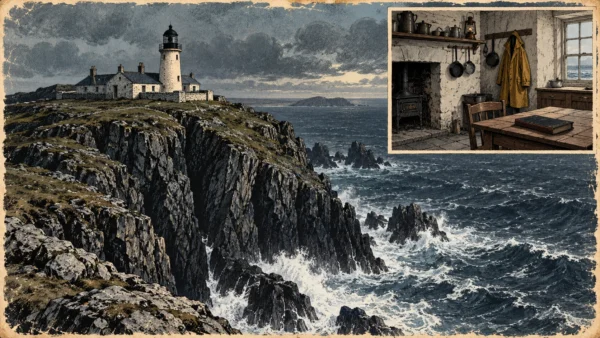
James Ducat, Thomas Marshall and Donald McArthur disappeared from the lighthouse on Eilean Mòr in December 1900. When the relief vessel Hesperus arrived on 26 December, Joseph Moore found the station deserted. The contemporary inquiry considered an exceptional wave the likeliest explanation.
The records consulted support the contemporary interpretation of a maritime accident without establishing the exact final sequence. They do not provide a reliable basis for a perpetrator narrative. [1]
Timeline
- The keepers are last seen on duty; the steamer Archtor reports that the light is not burning.
- The relief vessel Hesperus reaches the island; Joseph Moore finds the station deserted.
- Superintendent Robert Muirhead arrives for the official inquiry.
- Muirhead’s report concludes the men were swept away by a large sea.
- The lighthouse is automated.
Status: Presumed maritime accident; precise sequence unresolved
Entry checked: 19 October 2026. AI-generated symbolic illustration.
Sources: Northern Lighthouse Board · National Records of Scotland · Wikipedia: Flannan Isles Lighthouse
No case matches this selection. Please change the search or the filters.
Where the trails end
The map loads its map data from OpenStreetMap once you scroll here. Every case is also listed above in the archive.
About this encyclopedia
STILL VANISHED is my true crime encyclopedia of cases that remain open to this day: people who vanished, crimes whose perpetrators were never found, and dead people who have no name. The range runs from Kaspar Hauser and Hinterkaifeck through the Somerton Man and the Isdal Woman to Madeleine McCann and Rebecca Reusch. Some cases are known to almost everyone, others are barely known outside their own country.
Every entry belongs to one of three categories. Missing covers cases in which a person’s whereabouts are unknown. A cold case is an unsolved crime or death in which the victim is known but the perpetrator or the course of events is not. Unidentified describes dead people whose names were never established, or only very late.
Many of these cases have grown legends around them, and online a legend travels faster than any correction. So I first record what is documented and label theories as theories. The basis is statements from police and prosecutors, court decisions, reliable media reports and specialist literature. For the Kris Kremers and Lisanne Froon case, my own analysis of the investigation files comes on top. For many cases, the blog series “Between the Shadows” offers an in-depth analysis. These cases carry a yellow “In-depth analysis” tag and a link to the article. The encyclopedia keeps growing.
How the entries are made
Documented facts first
The basis is statements from police and prosecutors, court decisions, serious reporting and specialist literature.
Theories named as theories
Hypotheses appear in an entry, but they are labelled as such. Where something has been refuted, I say so.
Respect for those affected
No crime scene photographs, and no suspicions aimed at people who have not been charged or convicted.
My true crime books

Frequently asked questions about STILL VANISHED
What is the STILL VANISHED encyclopedia?
STILL VANISHED is a reference work on unsolved disappearances, cold cases and dead people without an identity, from Germany and around the world. It brings together cases from Kaspar Hauser to Rebecca Reusch. Each entry sums up the documented facts and keeps them apart from theories and rumour.
What is a cold case?
A cold case is an unsolved crime that is no longer actively investigated because no new leads are available. New traces, better DNA methods or genetic genealogy can lead to such a case being reopened decades later.
What is the difference between a missing persons case and a cold case?
In a missing persons case, where a person is remains unknown. A cold case is an unsolved crime or death in which the victim is known but the perpetrator or the course of events is not. The third category in this encyclopedia is dead people whose identity was never established, or only very late, such as the Isdal Woman or the Somerton Man.
Which sources does the encyclopedia use?
Publicly available information: statements from police and prosecutors, court decisions, reporting by established media and specialist literature. For the Kris Kremers and Lisanne Froon case, my own analysis of the investigation files is added. Anything that is merely claimed or assumed is marked as a theory.
How up to date are the entries?
The entries reflect the state of September 2026. Where investigations are ongoing, as in the Rebecca Reusch or Madeleine McCann cases, the situation can change at any time. What the responsible authorities say then takes precedence.
Do the images show victims or crime scenes?
No. The images belonging to the cases are symbolic images, not photographs from the investigations.
What should I do if I have information about a case?
Information belongs directly with the responsible police force or public prosecutor, not in social networks or comment sections. Spreading names and suspicions in public can harm uninvolved people and damage an investigation.
Information about a case belongs with the police or the public prosecutor. The entries are based on publicly available information (as of September 2026) and are no substitute for official statements.
The images belonging to the cases are symbolic images, not photographs from the investigations. The German version of this encyclopedia: SPURLOS.