

An archive of unsolved mysteries, where the trail fades into shadow — separating fact from fiction.
Episode 10
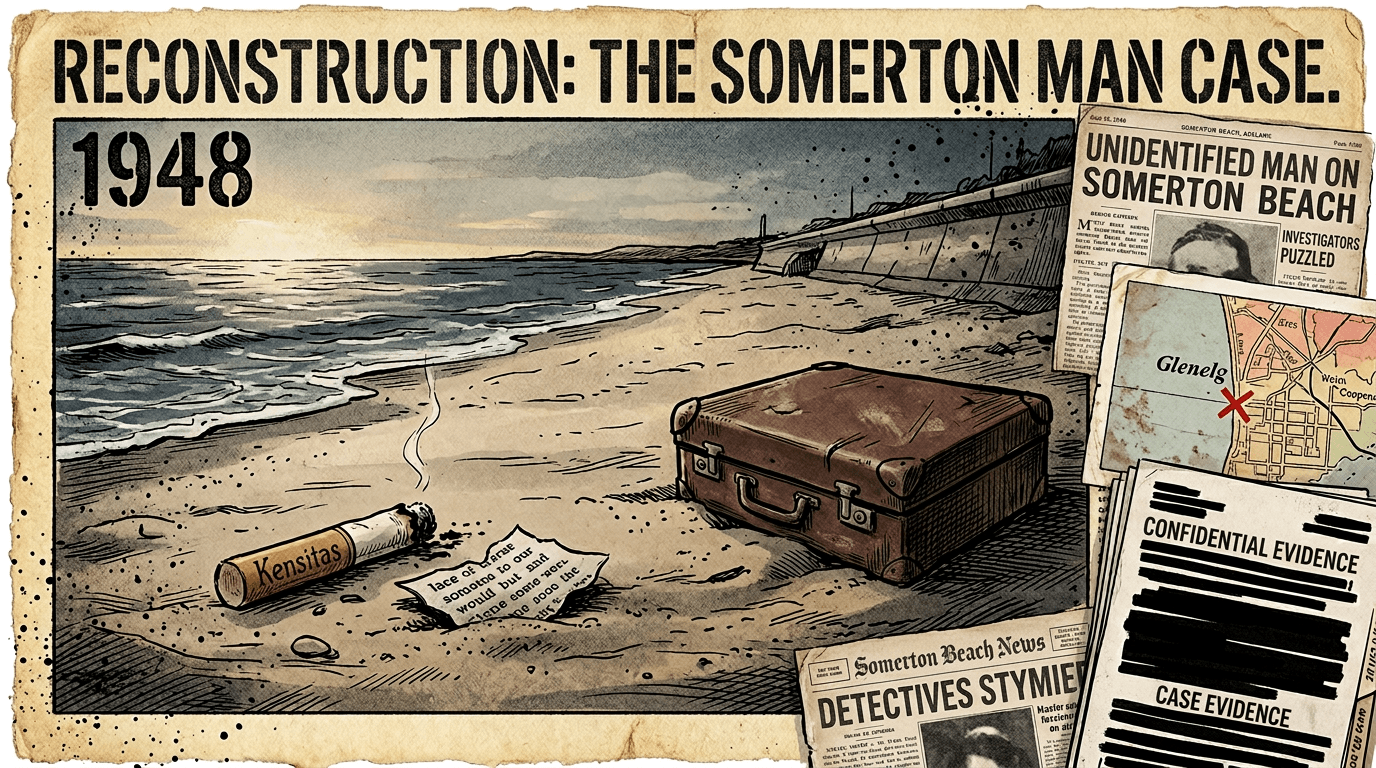
The Somerton Man: The Tamám Shud Mystery Explained
A dead man on an Adelaide beach, a tiny slip of paper reading “Tamám Shud” and a code no one has ever cracked. For more than 70 years, the Somerton Man was Australia’s greatest mystery. In 2022 he finally got a name – but the biggest question remains.
Case File at a Glance
On the morning of December 1, 1948, people walking along Somerton Park beach near Adelaide found a dead man. He was propped against the seawall, neatly dressed in a suit and polished shoes, as if he had simply fallen asleep. Witnesses had seen him lying there the evening before and assumed he was drunk. He carried no ID. And every label had been removed from his clothing.
The autopsy found no injuries but signs of organ failure. The pathologist suspected poisoning but could not identify any poison. So began one of the most baffling cases of the 20th century: the mystery of the Somerton Man.
“Tamám Shud”: The Slip in the Hidden Pocket
Months later, a closer examination turned up a tiny rolled-up scrap of paper in a hidden fob pocket of the dead man’s trousers. Printed on it were two words: “Tamám Shud.” The Persian phrase means “ended” or “finished.” It is the final line of the Rubaiyat of Omar Khayyam, a famous collection of verses about mortality and living in the moment.
Police issued a public appeal. Soon a man came forward: he had found a copy of the Rubaiyat in the back of his car, parked near the beach. The piece torn from its last page matched the slip. On the back cover were a phone number and five lines of capital letters – an apparent code.
The Somerton Man Code and the Nurse
Naval cryptographers, mathematicians and thousands of hobbyists have studied the five lines. None has decoded them. One popular reading suggests they are the first letters of words, a kind of memory aid. That remains unproven.
The phone number led to a young nurse who lived near the beach. She said she did not know the dead man, though investigators reported she appeared visibly shaken when shown a plaster cast of him. She insisted her identity be protected and took whatever she knew – if she knew more – to her grave. Her reaction proves neither guilt nor a definite connection.
There was more. A suitcase left at Adelaide’s railway station was linked to the man, and almost every label in it had been removed as well. Those details, the code and the early Cold War climate soon fueled a spy theory. To this day, there is no evidence for it.
2022: Who Was the Somerton Man?
His remains were exhumed in 2021. In July 2022, University of Adelaide professor Derek Abbott and U.S. forensic genealogist Colleen Fitzpatrick announced that they had identified him using DNA from his hair and genealogical research: Carl “Charles” Webb, an electrical engineer from Melbourne born in 1905. Webb had separated from his wife and then vanished from the records.
South Australian authorities ran their own forensic analysis in parallel and were more cautious in public. Still, most observers consider the identity largely settled. But that answers only one question: who he was. Why he died, why he was in Adelaide, why the labels were missing and what the code means are still open.
Where the Somerton Man Case Stands Today
The Somerton Man is now a cold case with a name. No definitive cause of death was ever established; poisoning is possible but unproven, as are suicide and foul play. The espionage theories remain speculation.
What makes this case unique is less the crime story than its poetry: a nameless man who, for decades, spoke only through two Persian words about endings. That he was finally identified through modern genetic genealogy also shows how investigations are changing – often driven by dedicated private researchers.
This case is documented in our archive
Explore the Somerton Man alongside 30+ other unsolved cases in the STILL VANISHED True Crime Encyclopedia.
Books by Christian Hardinghaus

Crowdsolving True Crime Files
How web sleuths, codebreakers and genetic genealogists investigate real cases. The Somerton Man shows what crowdsolving can achieve.
Book Details Get on Amazon
Still Lost in Panama
The definitive account of the 2014 disappearance of Kris Kremers and Lisanne Froon in the Panamanian jungle.
Book Details Get on AmazonThis article is based on publicly available sources and is presented with respect for those affected. Where theories or unconfirmed claims are discussed, they are clearly identified as such. It serves informational and documentary purposes. If you have information related to this case, please contact the relevant authorities.