

An archive of unsolved mysteries, where the trail fades into shadow — separating fact from fiction.
Episode 03
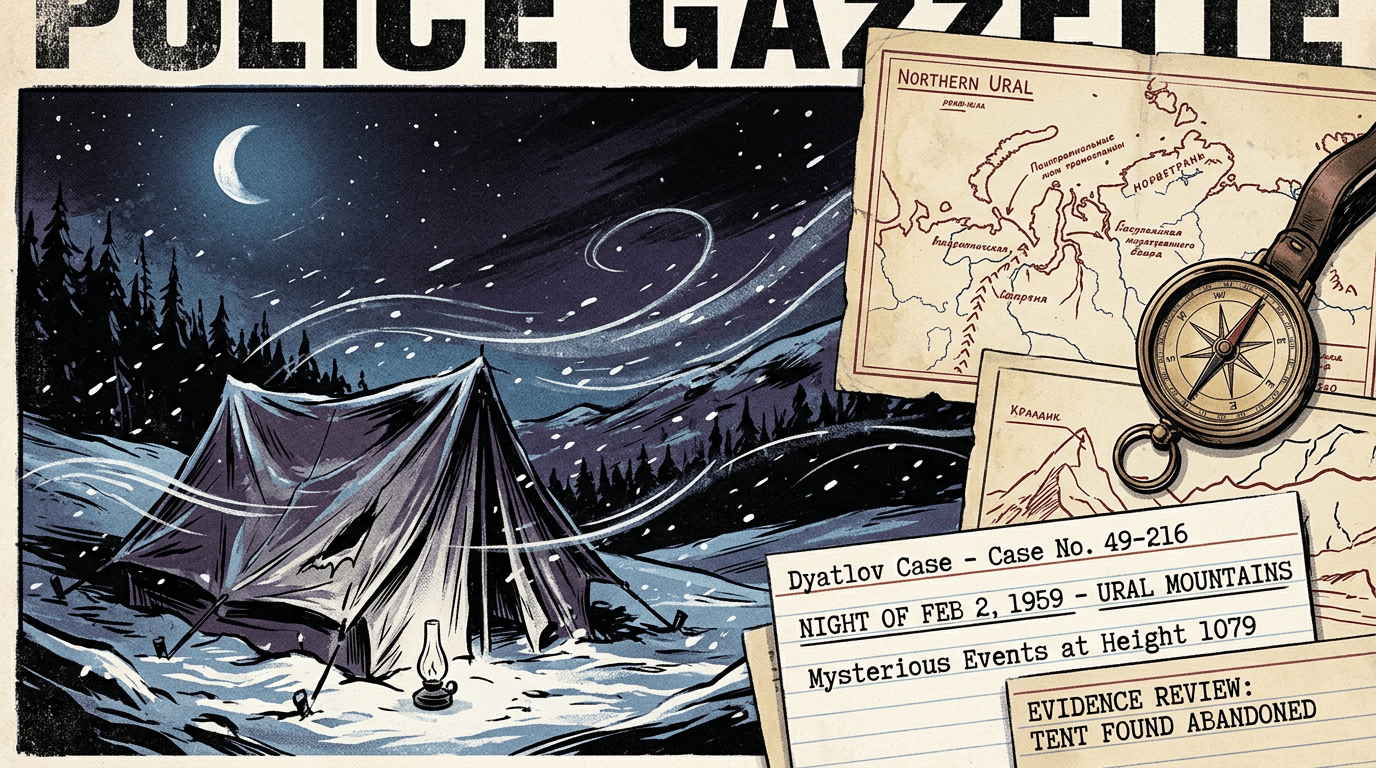
The Dyatlov Pass Incident: Nine Hikers, One Frozen Mystery
In 1959, nine experienced hikers died in the northern Ural Mountains after fleeing their tent into the snow. Official explanations have shifted over time, but the strange evidence left behind turned the tragedy into one of the most debated mysteries of the twentieth century.
Case File at a Glance
There are mysteries that begin with absence: a missing person, an empty road, a room without a name. The Dyatlov Pass Incident begins with something more physical and more disturbing — a tent cut open from the inside, footprints leading down a frozen slope, and nine young hikers found dead across a snow-covered landscape that seemed to preserve both evidence and confusion.
In early 1959, a group of experienced Soviet hikers set out across the northern Ural Mountains. They were young, skilled, and prepared for a difficult winter expedition. Their leader was Igor Dyatlov, a 23-year-old engineering student. By the time searchers found their camp weeks later, the expedition had become a puzzle that would outlive the Soviet Union itself.
Why This Case Still Resonates
The Dyatlov Pass Incident remains compelling because many of its details appear to resist the calm logic of a mountain accident. The hikers left their tent in subzero conditions without adequate clothing. Some were found near a cedar tree, others between the tree and the camp, and four more were later discovered in a ravine with severe internal injuries. The tent appeared to have been cut open from the inside. Several bodies showed signs of extreme cold exposure; others had trauma that seemed, at first glance, difficult to reconcile with a simple escape from a tent.
The original Soviet investigation closed the case with a famously opaque phrase: the hikers had died because of an “unknown compelling force.” That wording did not resolve suspicion. It created a vacuum. Into that vacuum came decades of theories — some grounded in weather and terrain, others in military secrecy, radiation, strange lights, Indigenous legends, animal attacks, and even extraterrestrial speculation.
Part of the case’s power lies in the youth of the victims. These were not anonymous figures in a distant landscape. They were students and graduates from the Ural Polytechnic Institute, photographed smiling, skiing, writing diary entries, and moving through a trip that was supposed to test endurance, not end in disaster. Their final images remain haunting because they are ordinary. The horror came later.
The Expedition Into the Urals
The group began as ten hikers: Igor Dyatlov, Zinaida Kolmogorova, Lyudmila Dubinina, Yuri Doroshenko, Yuri Krivonischenko, Rustem Slobodin, Alexander Kolevatov, Nikolai Thibeaux-Brignolle, Semyon Zolotaryov, and Yuri Yudin. Their goal was a challenging winter route through the northern Urals, including the area around Otorten mountain. The expedition was considered demanding, but within the capabilities of the team.
Yuri Yudin became ill early in the trip and turned back, a decision that saved his life. The remaining nine continued. Their diaries and photographs show a group dealing with cold, snow, logistical frustrations, and the ordinary humor of a difficult journey. Nothing in the surviving record clearly suggests they expected an extraordinary threat.
By February 1, the hikers reached the slopes of Kholat Syakhl, often translated from the local Mansi language as “Dead Mountain,” though the meaning and folklore have sometimes been exaggerated in later retellings. Due to weather and navigation difficulties, the group pitched their tent on an exposed slope rather than descending into the forest. That decision would later become central to the avalanche theory.
When the hikers failed to return as scheduled, concern grew. Search teams eventually located the abandoned tent on February 26. It was partially collapsed and covered by snow. Inside were boots, warm clothing, supplies, and personal items — exactly the things a rational person would take before stepping into lethal cold. Yet footprints led away from the tent toward the forest below.
The Bodies in the Snow
The first bodies were found near the edge of the forest. Yuri Doroshenko and Yuri Krivonischenko were discovered near a cedar tree, lightly dressed, close to the remains of a small fire. Branches above them appeared broken, suggesting someone may have climbed the tree, perhaps to look back toward the tent or escape exposure at ground level.
Three more hikers — Igor Dyatlov, Zinaida Kolmogorova, and Rustem Slobodin — were found between the cedar and the tent, positioned in a way that suggested they may have tried to return uphill. All five were judged to have died primarily from hypothermia, though Slobodin also had a skull injury that has been discussed extensively. The injury was not necessarily fatal by itself, but it added to the case’s unsettling complexity.
The remaining four were not found until May, when melting snow exposed a ravine. Lyudmila Dubinina, Alexander Kolevatov, Nikolai Thibeaux-Brignolle, and Semyon Zolotaryov were discovered under several meters of snow. Some wore clothing taken from those who had died earlier, a fact often misrepresented as suspicious but consistent with desperate survival behavior in extreme cold.
The ravine group showed more severe injuries. Dubinina and Zolotaryov had major chest trauma, and Thibeaux-Brignolle had a serious skull fracture. Dubinina was also missing her tongue and other soft tissue, a detail that has fueled decades of sensational claims. However, decomposition, scavenging, and water exposure can account for soft tissue loss after death. The injury pattern remains debated, but the missing tongue alone is not proof of torture, ritual violence, or anything supernatural.
Theories That Persist
The avalanche theory is the most widely accepted natural explanation and has been strengthened by later reviews and scientific modeling. One version holds that the hikers pitched their tent on a slope where a slab avalanche or delayed snow slide became possible. If they heard or felt snow pressing against the tent, they may have cut their way out and retreated downslope, believing the tent unsafe. In the darkness, wind, and cold, they may have been unable to return.
Critics of the avalanche theory have pointed out that the slope did not look like a classic avalanche site and that the tent was not completely swept away. Supporters respond that a small slab movement could have been enough to terrify the group, injure some members, and make the tent temporarily unusable without producing the dramatic avalanche debris many people imagine. Modern simulations have suggested that unusual snow loading and terrain conditions could have produced injuries comparable to those found on some victims.
Another theory involves katabatic winds or extreme weather. According to this interpretation, sudden violent winds may have made the exposed slope intolerable or convinced the hikers that remaining in the tent was dangerous. This theory explains the urgency and the retreat toward the forest, but it does not fully account for the severe injuries found in the ravine group unless combined with falls, snow collapse, or other trauma after leaving the tent.
A third theory centers on military testing. Supporters point to reports of strange lights in the sky, traces of radioactivity on some clothing, and the Soviet state’s secrecy. The region and era make such speculation understandable, and the Soviet handling of information did little to build public trust. However, no confirmed public evidence proves that the hikers were killed by a weapons test, missile accident, or military unit. The radiation levels reported on clothing have been interpreted in different ways and do not, by themselves, establish a military cause.
Some researchers have proposed that the group encountered criminals, escaped prisoners, or hostile outsiders. This theory attempts to explain why the hikers fled the tent, but it struggles with the lack of clear evidence for a violent human attack: no confirmed defensive wounds consistent with a massacre, no known robbery motive, and no established perpetrator. The Mansi people, Indigenous to the region, were examined during the original investigation, but there has never been credible evidence that they attacked the hikers. Later insinuations against them should be treated with caution and respect.
Other theories are more speculative. Infrasound from wind patterns has been suggested as a possible cause of panic. Animal attack theories have been raised, though the evidence does not strongly support them. UFO and paranormal explanations remain part of popular culture around the case, but they are not supported by verifiable evidence. They endure because the scene feels irrational — not because they solve it better than natural explanations.
What Later Investigations Concluded
The original 1959 Soviet investigation was brief, limited, and unsatisfying. Its conclusion that the hikers died because of an “unknown compelling force” was not a scientific explanation so much as an administrative endpoint. Files were closed, access was limited, and public discussion remained constrained for years.
Decades later, after renewed attention from journalists, researchers, relatives, and the public, Russian authorities reopened a review of the case. In 2020, prosecutors stated that the most likely cause was an avalanche-related scenario, specifically involving snow movement and the hikers’ desperate attempt to survive after leaving the tent. This explanation placed the tragedy within the realm of environmental accident rather than crime or conspiracy.
Not everyone accepted that conclusion. Relatives, independent researchers, and Dyatlov Pass investigators have continued to challenge aspects of the avalanche model. Their objections often focus on the slope angle, the condition of the tent, the timing of injuries, and the behavior of experienced hikers. The official position may be closed, but public debate remains open.
In practice, the modern understanding of the Dyatlov Pass Incident is less binary than many retellings suggest. It is not simply “avalanche solved” versus “paranormal mystery.” A plausible natural explanation can coexist with unresolved details. Extreme environments produce chaotic outcomes. Human decisions under fear, darkness, injury, and hypothermia can appear irrational afterward, especially when reconstructed weeks later from damaged evidence.
Where the Case Stands Today
The Dyatlov Pass Incident is officially treated as the result of natural forces, with avalanche or snow-slab conditions as the leading explanation. Yet the case remains disputed in the public imagination because no reconstruction has answered every question to everyone’s satisfaction. The evidence is old, the scene was disturbed by weather and search activity, and the original investigation left gaps that later science can narrow but not fully erase.
The enduring lesson of the case may be less about monsters in the snow and more about the danger of certainty. The hikers were real people, not characters in a supernatural puzzle. They were young, capable, and unlucky in a landscape where small errors can become irreversible. Whatever forced them from the tent, the final hours were likely marked by cold, injury, confusion, and desperate attempts to survive.
The myths around Dyatlov Pass will probably never vanish. They are part of the case’s afterlife. But separating fact from fiction brings the tragedy back into focus: nine hikers entered the Ural wilderness in winter, encountered something they could not overcome, and died before anyone could reach them. The mountain kept its silence. The world supplied the theories.
This case is documented in our archive
Explore the Dyatlov Pass Incident alongside 30+ other unsolved cases in the STILL VANISHED True Crime Encyclopedia.
Books by Christian Hardinghaus

Crowdsolving True Crime Files
18 international cold cases explored in depth — plus a bonus collection of 20 lesser-known German cold cases rarely covered in English.
Book Details Get on Amazon
Still Lost in Panama
The definitive account of the 2014 disappearance of Kris Kremers and Lisanne Froon in the Panamanian jungle.
Book Details Get on AmazonThis article is based on publicly available sources and is presented with respect for those affected. Where theories or unconfirmed claims are discussed, they are clearly identified as such. It serves informational and documentary purposes. If you have information related to this case, please contact the relevant authorities.