

An archive of unsolved mysteries, where the trail fades into shadow — separating fact from fiction.
Episode 02
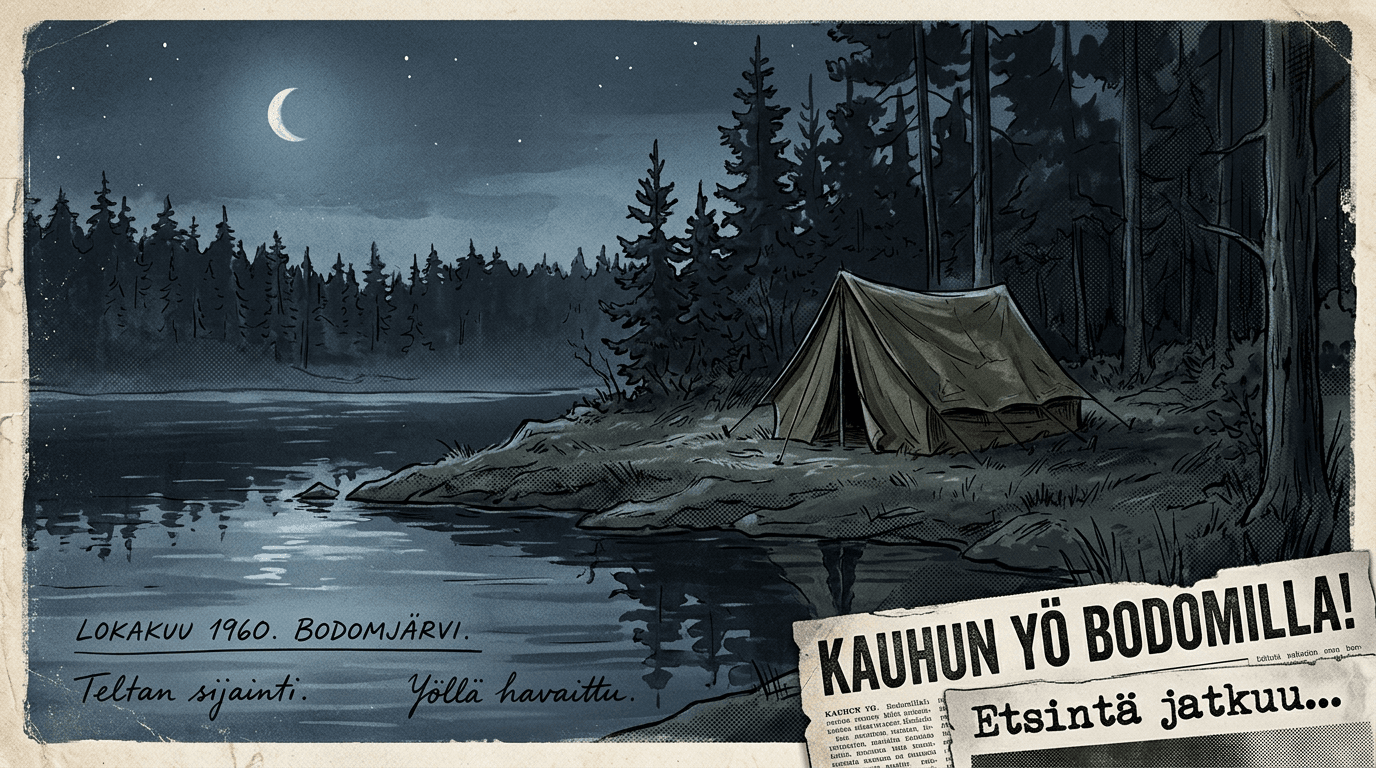
The Lake Bodom Murders: Finland’s Campsite Mystery
In June 1960, four teenagers went camping by Lake Bodom near Espoo, Finland. By morning, three were dead, one was badly injured, and the question of who attacked them has haunted Finland for more than six decades.
Case File at a Glance
Lake Bodom lies only a short distance from Helsinki, but in the Finnish imagination it occupies a much darker place: a lakeside campsite where a youthful weekend trip became one of the country’s most notorious unsolved crimes. On the night of June 4 to 5, 1960, four teenagers camped near the shore. By morning, three had been killed and the fourth was found seriously injured.
The victims were 15-year-old girls Maila Irmeli Björklund and Anja Tuulikki Mäki, and 18-year-old Seppo Antero Boisman. The sole survivor was 18-year-old Nils Wilhelm Gustafsson. The attack was brutal, sudden, and still not definitively explained. More than sixty years later, the Lake Bodom murders remain one of Finland’s defining cold cases.
Why This Case Still Resonates
The Lake Bodom case endures because it contains several elements that make a mystery hard to leave alone: a remote but accessible location, young victims, a surviving witness with limited memory, stolen items, conflicting sightings, and a later prosecution that ended without a conviction. It is not simply a murder case without an offender. It is a case in which many explanations have seemed possible, yet none has been proven.
The setting adds to the unease. Camping should have meant freedom, summer, friendship, and escape from ordinary routines. Instead, the tent became the center of a crime scene. The idea that the attacker may have approached the sleeping teenagers in the early hours of the morning has made the case especially haunting. It transforms a familiar image — young people sleeping outdoors — into something vulnerable and exposed.
Lake Bodom has also remained culturally significant in Finland because the case never faded into mere archive material. It resurfaced repeatedly through media coverage, books, documentaries, public speculation, and eventually a dramatic legal turn decades later, when the surviving camper himself was charged and later acquitted.
The Night at Lake Bodom
On June 4, 1960, the group arrived at Lake Bodom for a camping trip. The teenagers pitched a tent near the shore and spent the evening in what appears to have been an ordinary outing. The following morning, the scene was discovered: the tent had collapsed or been damaged, three of the campers were dead, and Nils Gustafsson was alive but severely injured.
The victims had suffered violent injuries. Public accounts have described the attack as involving blunt force trauma and stabbing wounds. Some personal items were missing from the campsite, including belongings connected to the victims. The theft or removal of these items has long puzzled investigators and researchers because it may suggest an offender attempting to stage a motive, collect trophies, hide evidence, or simply create confusion.
Gustafsson survived but had serious injuries, including facial trauma. He later stated that he had little or no memory of the attack itself. This lack of memory became both understandable and controversial. For supporters of his innocence, it was consistent with severe trauma. For later skeptics, it left a gap into which suspicion could grow.
The early investigation faced the limitations of its era. Forensic science in 1960 was not what it is today. Crime scene preservation standards were different, public curiosity was intense, and some potential evidence that might have been decisive in a modern investigation could not be exploited with the same precision then.
The Search for a Killer
In the years after the murders, Finnish authorities examined multiple leads. The case attracted numerous suspects and theories, some based on witness statements, some on local rumors, and others on attempts to interpret the crime scene after the fact. None led to a final conviction.
One of the most discussed figures in public accounts was a local kiosk keeper, often described as having behaved suspiciously or having a hostile attitude toward campers. Some theories alleged that he may have been involved, but these claims were never proven in court. Over time, he became part of the case mythology, illustrating how unsolved crimes can attach suspicion to eccentric or unpopular local figures without producing legal certainty.
Another line of suspicion involved possible unknown outsiders — someone passing through the area, a violent stranger, or a person who encountered the group during the night. This theory fits the fear at the center of the case: that the teenagers were attacked by someone who vanished into the landscape and never re-entered the investigation in a recognizable way. Yet without a confirmed identity, motive, or forensic match, the stranger theory remains broad rather than conclusive.
There were also reports of sightings in the area around the time of the murders, including accounts of a man moving near the crime scene. Such witness claims are common in major cases, especially once media attention grows. Some may be meaningful; others may be mistaken, exaggerated, or influenced by later knowledge. In the Lake Bodom case, no sighting has publicly resolved the identity of the killer.
Theories That Persist
One theory holds that the murders were committed by an unknown attacker who approached the tent during the early morning hours. Supporters of this interpretation point to the suddenness of the attack, the missing items, and the lack of a proven motive among the teenagers themselves. In this view, Gustafsson survived because he was injured but not killed, perhaps because the attacker assumed he was dead or fled before ensuring it.
A second theory has focused on the possibility of a local offender familiar with the area. Lake Bodom was not an isolated wilderness beyond human reach. Someone who knew the terrain could have approached and left without being easily tracked. This theory often overlaps with suspicion toward local individuals, but familiarity with the area alone does not identify a killer.
A third and highly controversial theory emerged decades later: that Nils Gustafsson, the survivor, may have killed the others. This theory became more than public speculation when he was arrested in 2004 and charged with the murders. Prosecutors suggested a possible conflict or emotional trigger among the group, but the case against him faced major evidentiary problems. In 2005, Gustafsson was acquitted. The court found that the evidence did not prove his guilt, and he has legally remained innocent of the charges.
Because Gustafsson was acquitted, any responsible discussion of the case must treat claims against him with caution. His survival and memory loss made him a focus of suspicion, but suspicion is not proof. The legal outcome matters: no court established that he committed the murders. The theory remains part of the case history, not a confirmed solution.
Some more speculative claims have appeared over the decades, including theories involving sexual motives, trophy-taking, revenge, or a mentally unstable passerby. These theories attempt to explain the violence and missing belongings, but they remain interpretations rather than verified facts. The evidence available to the public does not allow a definitive motive to be assigned.
The 2004 Arrest and 2005 Trial
The most dramatic development came more than forty years after the killings. In 2004, Finnish police arrested Nils Gustafsson, the only survivor of the attack. The decision shocked the public. For decades, he had been known primarily as the young man who lived through the Lake Bodom murders. Suddenly, he was being investigated as the possible perpetrator.
The prosecution argued that Gustafsson may have attacked his friends after some form of dispute. The defense rejected this, emphasizing his injuries, the weakness of the evidence, and the difficulty of reconstructing events after so many years. Modern forensic review was brought into the case, but the passage of time made certainty elusive.
In 2005, Gustafsson was acquitted of all charges. The court concluded that the evidence was insufficient to prove that he had killed Björklund, Mäki, and Boisman. The acquittal did not solve the case; it returned it to the category where it had long existed — officially unresolved, publicly debated, and emotionally unfinished.
The trial remains important because it demonstrates both the possibilities and dangers of cold case prosecution. Old evidence can sometimes speak more clearly through modern science. But age can also distort context, weaken memories, and tempt investigators or the public toward narratives that fill gaps too confidently.
Where the Case Stands Today
The Lake Bodom murders remain unsolved. Three teenagers were killed, one survived, and no one has been convicted. The crime has become part of Finnish criminal history not only because of its brutality, but because it has resisted closure across generations.
What is known is limited but devastating. A group of young people camped by a lake. During the night or early morning, they were attacked. Three died at the scene. One lived with injuries and fragmented memory. Items were missing. Leads multiplied. The decades passed.
The unanswered questions remain painfully simple: Who approached the tent? Why were these teenagers targeted? Were the missing items evidence of motive, staging, or panic? Did the killer know the victims, or did they represent a random opportunity? And how did a crime so violent leave behind so much attention, yet no final answer?
Lake Bodom is still there, quiet and ordinary in daylight. That may be the most unsettling part. Places do not keep mysteries because they look cursed. They keep them because something happened there that human investigation could not fully explain. In the case of Lake Bodom, the water, the trees, and the old campsite remain fixed in memory — a summer night preserved in shadow.
This case is documented in our archive
Explore the Lake Bodom murders alongside 30+ other unsolved cases in the STILL VANISHED True Crime Encyclopedia.
Books by Christian Hardinghaus

Crowdsolving True Crime Files
18 international cold cases explored in depth — plus a bonus collection of 20 lesser-known German cold cases rarely covered in English.
Book Details Get on Amazon
Still Lost in Panama
The definitive account of the 2014 disappearance of Kris Kremers and Lisanne Froon in the Panamanian jungle.
Book Details Get on AmazonThis article is based on publicly available sources and is presented with respect for those affected. Where theories or unconfirmed claims are discussed, they are clearly identified as such. It serves informational and documentary purposes. If you have information related to this case, please contact the relevant authorities.