
Check the facts. Examine the clues. Keep questions open.
Episode 12
Yuba County Five: Why Did the Five Men Leave Their Car?
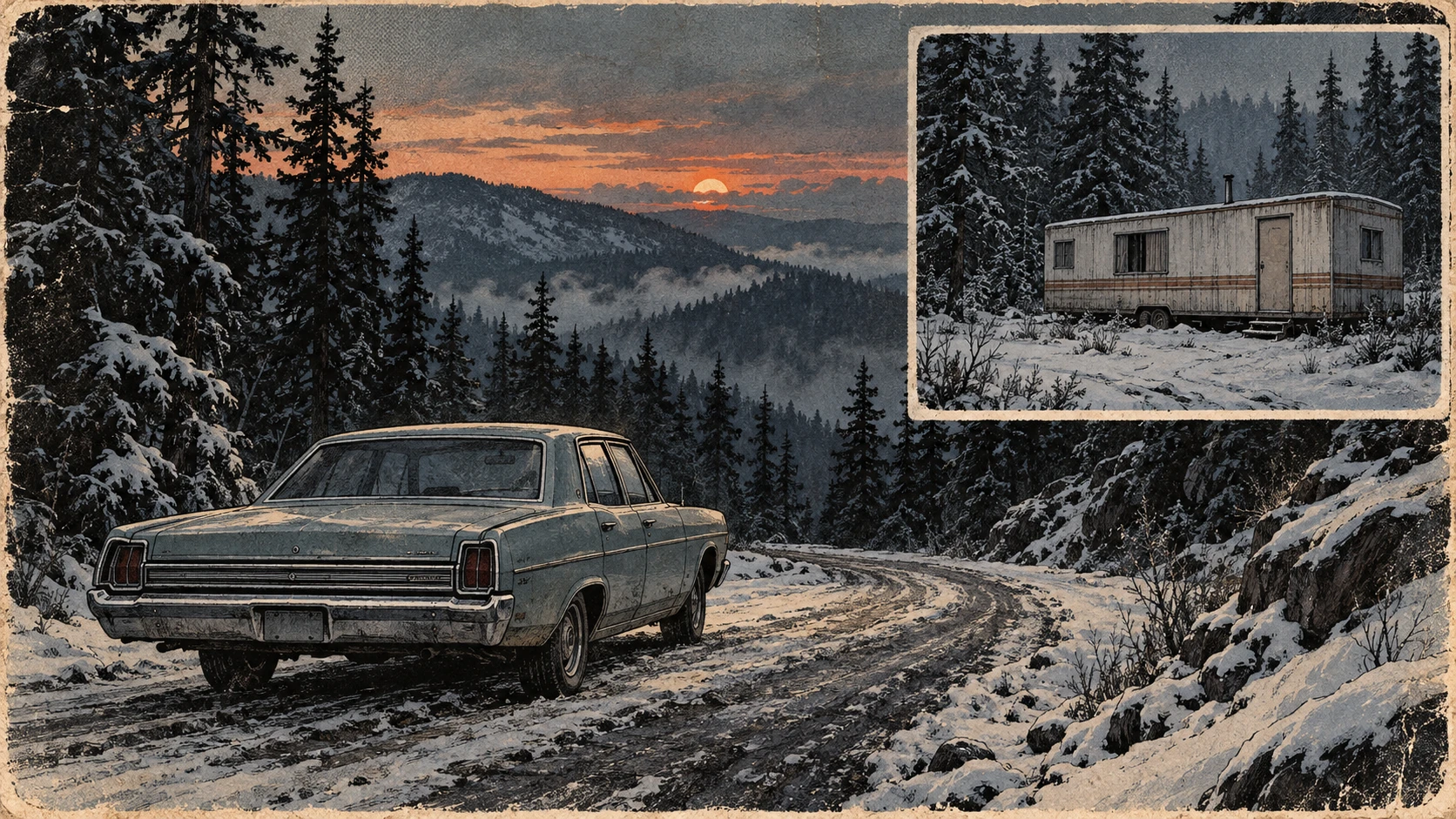
A car on a snowy mountain road, four men later found dead and one still missing. In the Yuba County Five case, knowing where the search ended does not explain the journey.
Case facts
What is known about the night?
Gary Mathias, Ted Weiher, Jack Madruga, Bill Sterling and Jackie Huett attended a basketball game in Chico on 24 February 1978. They did not return home. Their car was later found on a snowy mountain road away from the expected route. Four men’s remains were found in June. Mathias remains missing. [1]
Two separate questions begin here: why did the group drive into the mountains, and why did they leave the car? An answer to the first does not automatically answer the second. A seamless account needs to bridge several gaps.
What can the abandoned car establish?
The case summary at Solve the Case describes the vehicle as operable. Its location is therefore an important clue. That does not establish that remaining there would have felt safe, or that someone forced the men to get out. [1]
A reconstruction must distinguish a later inspection from the situation during the night. What could the group see? What options did they believe they had? What did they think lay ahead? The recovered vehicle cannot answer all of those questions. Mechanical condition and a person’s perception of danger are different kinds of information.
The forestry trailer: shelter and uncertainty
Weiher was found inside a forestry trailer a considerable distance from the car. Supplies were present. This became the case’s most troubling contrast: how could someone die where resources for survival appeared to exist? [1]
It is a reasonable question. The quick conclusion that an obvious rescue was deliberately ignored is much harder to justify. Access, knowledge, physical condition and timing all matter. An inventory made after a death cannot by itself show what a weakened person could previously reach or use.
Why Gary Mathias is not a ready-made explanation
Mathias was not found. That unresolved fact does not establish that he harmed his companions. We cannot repair a gap in the chronology by assigning responsibility to the person whose final movements are least known.
The direction of an inference matters. An established action may support a theory. A theory cannot supply evidence that the action happened. Repetition does not reverse that relationship, even when an account seems to explain an especially strange detail.
What remains unresolved?
The recovery sites document a catastrophe; they do not provide a complete shared route. Disorientation, an accident or an external threat each require evidence. None becomes certain simply because later observers find the decisions incomprehensible.
For me, this is the central difficulty. We know the outcome; the men did not. A fair reconstruction tries to understand the options they perceived at the time, rather than judging every choice from the eventual discoveries.
Frequently asked questions
Were all five men found?
No. Four were found dead; Gary Mathias remains missing.
Why did they leave the car?
No complete, established explanation accounts for that decision.
Do the supplies in the trailer prove a crime?
No. Their presence alone cannot establish the men’s condition or reconstruct events.
Books by Christian Hardinghaus

Hooked on True Crime
Why do unresolved cases hold our attention? My book examines internet sleuthing, the search for answers and the responsibility that comes with it.
Explore the book →
Still Lost in Panama
With Annette Nenner, I investigated the disappearance of Kris Kremers and Lisanne Froon. This book follows that separate case in depth; it does not imply a shared explanation for different disappearances.
Explore the book →Panama: digital forensics and timeline · Kris & Lisanne: case lexicon
Sources and context
Research date: 19 October 2026. Linked sources support the attributed facts; discussion of inferences is my editorial analysis. Developments after this date are not anticipated here.