

Untold Stories, Hidden Facts & Curiosities of World War II — What’s Not in the Textbooks · by Dr. Christian Hardinghaus
Konrad Morgen at Nuremberg: The SS Judge Who Testified Before the Tribunal
Eighty years ago the International Military Tribunal in Nuremberg put the major war criminals on trial. Among the witnesses was a man in SS uniform who had investigated SS members in the camps: Konrad Morgen.
Nuremberg, August 8, 1946. The trial of the major war criminals is entering its final phase, and the organizations are on the table: is the SS as a whole a criminal organization? The defense of the SS calls a witness who obtained arrest warrants against concentration camp commandants. He is himself an SS judge.
01The Witness the Court First Did Not Want to Hear
Konrad Morgen, born in Frankfurt am Main in 1908, was a lawyer in the SS court system. He held the rank of SS-Sturmbannführer in the Waffen-SS, roughly a major by army standards (see the SS and Wehrmacht rank comparison table). At the Nuremberg trial of the major war criminals he was called as a witness for the defense of the SS, represented by counsel Dr. Pelckmann.
It was far from certain that he would testify in person. According to the transcript of August 7, 1946, the Tribunal first declared that Morgen would have to speak through his affidavits. On the following day, the 198th day of the trial, he was heard after all.
02What Morgen Told the Tribunal
Morgen described the investigations that had taken him through several camps from 1943 on. At Buchenwald he had investigated the commandant, Karl Otto Koch, who was later tried and executed by the SS itself. At Lublin he came, by his account, across Christian Wirth, who ran extermination camps. At Auschwitz an inquiry into smuggled gold took him into the camp. There, by his own account, he accused Maximilian Grabner, head of the Political Department, of about 2,000 killings outside the actual extermination operations.
Morgen also stated that he passed his findings to senior officials, including Arthur Nebe, Ernst Kaltenbrunner and Heinrich Müller, and that his prosecutions prevented further killings. That is his own account. It was valuable to the SS defense because it could be read as evidence that the killing was not carried by the organization as a whole.
03Why His Testimony Still Unsettles
The Tribunal did not follow that reading. In its judgment of September 30 and October 1, 1946, it declared the SS a criminal organization. Morgen’s testimony nevertheless shows something essential: even inside the SS there was a judiciary that prosecuted individual perpetrators for corruption, brutality and murder, while the machinery of extermination stayed untouched. That contradiction is the core of his biography: a lawyer in SS uniform applying law in a state that destroyed the law.
Morgen later gave evidence in further proceedings, including affidavits in the Nuremberg Doctors’ Trial and the Pohl Trial and testimony in the Frankfurt Auschwitz Trial. How credible and how complete his self-portrait is remains a subject of research.
✚Myth-Check
The claim: “Morgen’s testimony at Nuremberg proves that the SS leadership did not approve of the killings in the camps.”
Morgen showed that investigations against individual SS members existed, including against commandants. For the question of the SS leadership’s responsibility for mass murder this was not decisive: the Tribunal still declared the SS a criminal organization, and the extermination camps Morgen reported on kept operating.
Verdict: COMPLICATED
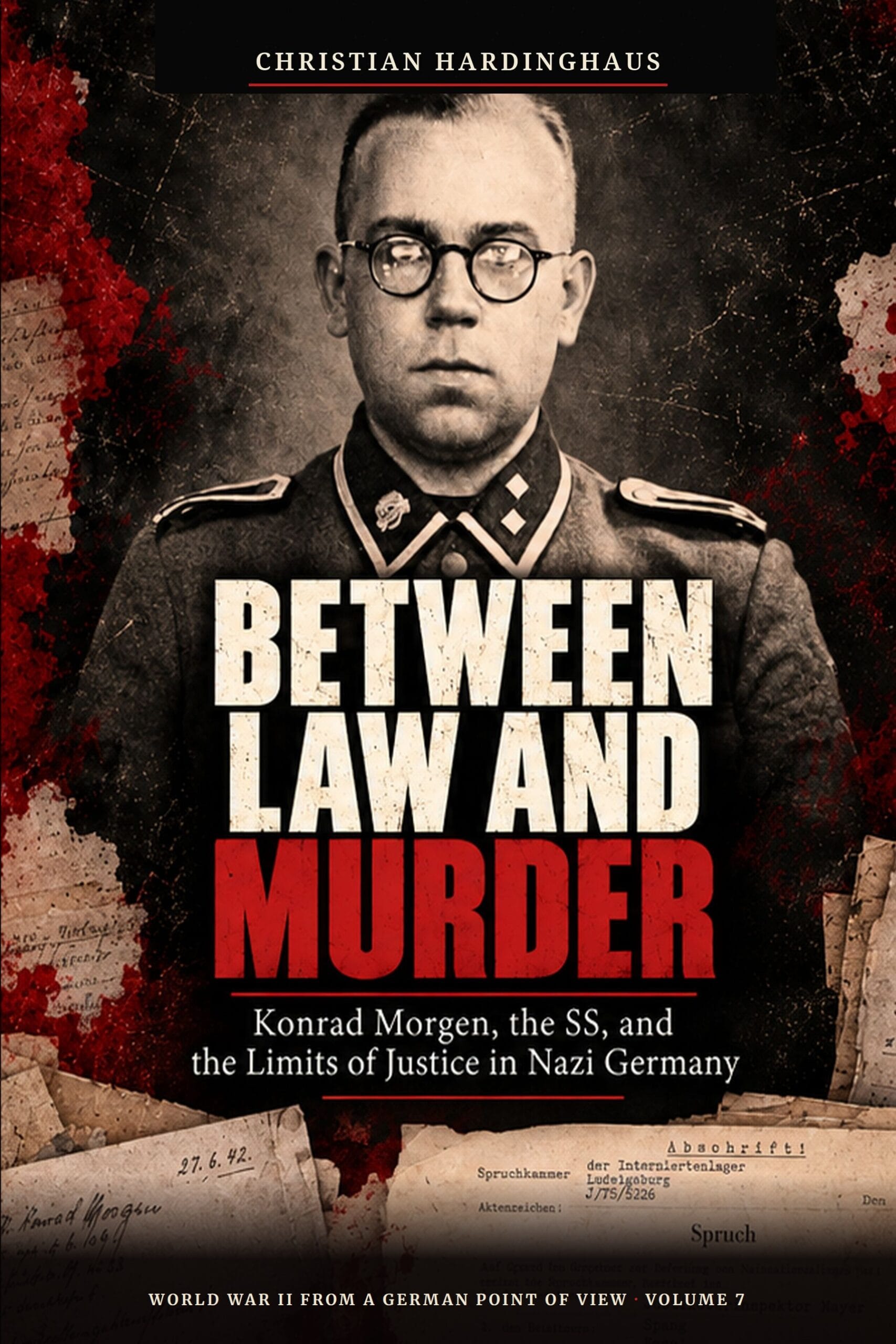
Between Law and Murder: Konrad Morgen, the SS, and the Limits of Justice
The biography reconstructs how Morgen investigated, where the limits of his power lay, and why he became a witness after 1945. A German edition, Der Fall Konrad Morgen, was published by Europa Verlag in January 2026.
View the book- International Military Tribunal, Nuremberg: transcripts of the 197th day (August 7, 1946) and the 198th day (August 8, 1946), testimony of Georg Konrad Morgen. Avalon Project, Yale Law School.
- Harvard Law School, Nuremberg Trials Project: documents by Georg Konrad Morgen (IMT testimony; affidavits in the Doctors’ Trial and the Pohl Trial).
- Christian Hardinghaus: Between Law and Murder. Hardinghaus Books, 2026.