
What rank was an SS-Obersturmbannführer in U.S. or German Army terms? Was an SS-Standartenführer equivalent to a colonel? And where did an SS-Hauptsturmführer fit? This guide compares the most important SS and Waffen-SS ranks with their German Army (Heer) counterparts and approximate U.S. Army equivalents during World War II. One caveat always applies: a comparable rank level did not mean the same job, command authority, political power, or institutional role.
Quick answer: common SS ranks in U.S. Army terms
- What U.S. Army rank was equivalent to an SS-Obersturmbannführer?
- Approximately Lieutenant Colonel; the German Army counterpart was Oberstleutnant.
- What was an SS-Hauptsturmführer?
- Approximately Captain; the German Army counterpart was Hauptmann.
- What was an SS-Standartenführer?
- Approximately Colonel; the German Army counterpart was Oberst.
- What was an SS-Sturmbannführer?
- Approximately Major.
- What was an SS-Brigadeführer?
- German Army Generalmajor; approximately U.S. Brigadier General.
- What was an SS-Gruppenführer?
- German Army Generalleutnant; approximately U.S. Major General.
SS ranks vs Wehrmacht: side-by-side rank chart
People often search for a “Wehrmacht equivalent,” but strictly speaking the Wehrmacht comprised the Army (Heer), Luftwaffe, and Kriegsmarine. The table below uses the German Army rank as the primary comparison, then gives an approximate U.S. Army equivalent. These are comparisons of rank level, not claims that the organizations, duties, or authority were identical. For a broader reference covering 137 German military, party, and auxiliary ranks, see the Nazi Germany Military Ranks Encyclopedia.
| SS / Waffen-SS rank | German Army equivalent | Approx. U.S. WWII equivalent |
|---|---|---|
| Enlisted ranks | ||
| SS-Mann | Schütze | Private |
| SS-Sturmmann | Gefreiter | Private First Class / acting corporal (approx.) |
| SS-Rottenführer | Obergefreiter | Corporal |
| Non-commissioned ranks (Unterführer) | ||
| SS-Unterscharführer | Unteroffizier | Sergeant |
| SS-Scharführer | Unterfeldwebel | Staff Sergeant |
| SS-Oberscharführer | Feldwebel | Technical Sergeant |
| SS-Hauptscharführer | Oberfeldwebel | Master Sergeant |
| SS-Sturmscharführer | Stabsfeldwebel | Sergeant Major |
| Officers | ||
| SS-Untersturmführer | Leutnant | Second Lieutenant |
| SS-Obersturmführer | Oberleutnant | First Lieutenant |
| SS-Hauptsturmführer | Hauptmann | Captain |
| SS-Sturmbannführer | Major | Major |
| SS-Obersturmbannführer | Oberstleutnant | Lieutenant Colonel |
| SS-Standartenführer | Oberst | Colonel |
| Senior officers and generals | ||
| SS-Oberführer | No exact Army equivalent | Senior-colonel level; no exact U.S. equivalent |
| SS-Brigadeführer | Generalmajor | Brigadier General |
| SS-Gruppenführer | Generalleutnant | Major General |
| SS-Obergruppenführer | General der Waffengattung | Lieutenant General |
| SS-Oberst-Gruppenführer | Generaloberst | General |
| Reichsführer-SS | Special SS leadership position; sometimes bracketed with Generalfeldmarschall | No direct U.S. equivalent |
What rank was an SS-Obersturmbannführer?
An SS-Obersturmbannführer corresponded by rank level to a German Army Oberstleutnant and is normally rendered in American English as Lieutenant Colonel. It stood between SS-Sturmbannführer (Major) and SS-Standartenführer (Colonel). In the Waffen-SS, an Obersturmbannführer could command a battalion or serve in a senior regimental post. In the General SS, police, concentration-camp system, or security apparatus, however, the same rank could be attached to a very different function.
What rank was an SS-Hauptsturmführer?
An SS-Hauptsturmführer corresponded roughly to a German Army Hauptmann and a U.S. Army Captain. In the Waffen-SS this was commonly a company-level officer rank. Below it stood SS-Obersturmführer, roughly First Lieutenant; above it SS-Sturmbannführer, roughly Major.
What rank was an SS-Standartenführer?
An SS-Standartenführer was comparable by rank level to a German Army Oberst and a U.S. Army Colonel. The term Standarte came from the organizational vocabulary of the SA and SS. Rank and function must still be separated: holding the rank Standartenführer did not necessarily mean that the officer was commanding a formation called a Standarte at that moment.
What was an SS-Brigadeführer in U.S. Army terms?
An SS-Brigadeführer corresponded to the German Army rank Generalmajor. In a wartime U.S. Army comparison, that level is approximately Brigadier General. For senior Waffen-SS officers, the military equivalent could appear in the full title, for example SS-Brigadeführer und Generalmajor der Waffen-SS. Above it came SS-Gruppenführer / Generalleutnant, approximately U.S. Major General.
Why does German Generalmajor map to U.S. Brigadier General?
This is one of the easiest traps in English-language rank tables. The German word Generalmajor looks like “Major General,” but the two armies did not place identically named ranks at the same step. In the World War II German hierarchy, Generalmajor was the first regular general-officer grade, followed by Generalleutnant. In a U.S. comparison, those levels align approximately with Brigadier General and Major General. That is why translating the German title word-for-word can produce a misleading U.S. equivalent.
Why does SS-Oberführer have no direct Army counterpart?
SS-Oberführer was a special SS grade between Standartenführer (Colonel) and Brigadeführer (Generalmajor). The German Army had no regular rank between Oberst and Generalmajor. English-language references therefore variously describe Oberführer as a Senior Colonel, a colonel-level special grade, or use an approximate general-officer analogy. The safest description is that it had no exact German Army or U.S. Army equivalent.
Were the SS and the Waffen-SS the same thing?
No. The SS was a much larger National Socialist organization encompassing multiple branches and institutions. The Waffen-SS was its armed, military branch. It was not part of the Wehrmacht, even though Waffen-SS formations could operate under Wehrmacht command in the field. The distinction matters when interpreting a rank: the same SS title could appear in a combat division, a police or security office, or another part of the SS apparatus.
Did an equivalent rank mean equivalent power?
No. An SS-Obersturmbannführer and an Army Oberstleutnant could occupy a comparable formal rank level while exercising completely different kinds of authority. This matters particularly for SS and police leaders, Security Service personnel, concentration-camp officials, and administrative officers. A historical figure should therefore never be interpreted from rank alone.
Rank or function?
Hauptmann was a rank; company commander was a function. Likewise, SS-Standartenführer was a rank, while command of a particular office, unit, police district, or staff was a function. If you encounter an SS rank in a service record, personnel file, trial document, or wartime source, check both questions: what rank did the person hold, and what position did he actually occupy?
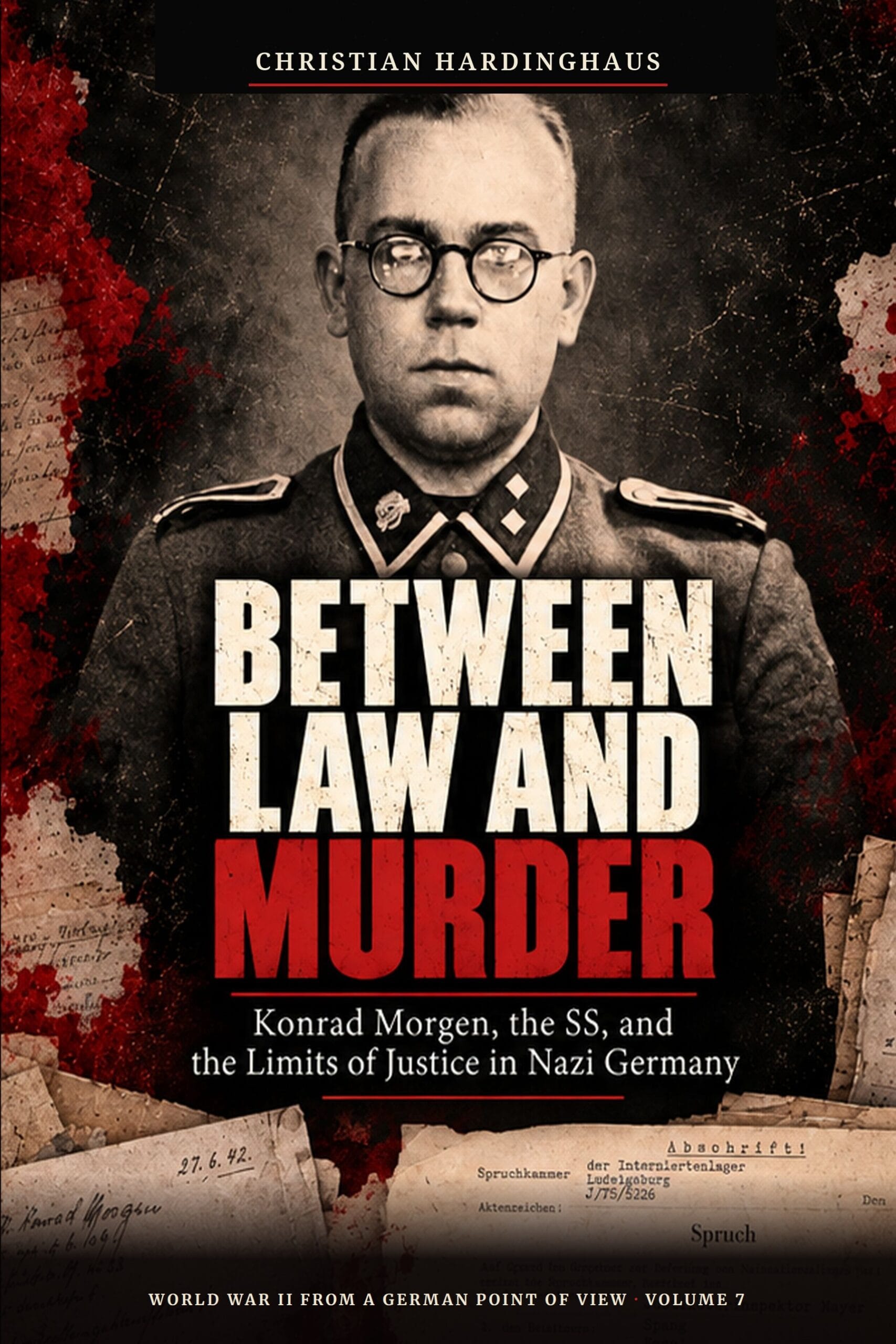
Further reading: Between Law and Murder
Rank is only part of the story. The biography of SS judge Konrad Morgen shows how rank, office, jurisdiction, and personal power could diverge inside the SS — from Buchenwald and Lublin to Auschwitz. About the book
Look up 137 German military and Nazi-era ranks
This page focuses on the search question “What was this SS rank equivalent to?” The Nazi Germany Military Ranks Encyclopedia goes wider: 137 ranks and grades across the Army, Luftwaffe, Kriegsmarine, SS, SA, NSDAP, Hitler Youth, and Reich Labour Service, with hierarchy, function, insignia, and cross-organization comparisons.