

Eight friends gather for dinner. Outside, a comet passes overhead; inside, old resentments surface between glasses of wine and small talk. Then another house contains the same table. Coherence needs only a short walk to make the familiar unsafe.
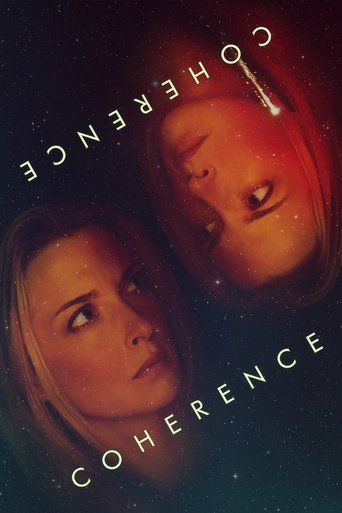
Coherence (2013)
Director: James Ward Byrkit
Cast: Emily Baldoni, Maury Sterling, Nicholas Brendon
The ending in brief
Em tries to take her double’s place in a more appealing parallel reality. The second ring and the call to Kevin undermine the security of that takeover. The most straightforward reading is that another Emily survives and makes contact. The film does not show the caller’s location or her subsequent journey.
What happens to reality in Coherence?
The comet is associated with multiple versions of the same evening. The dark area between houses allows movement between them. Someone who goes outside may enter an apparently familiar home whose occupants have experienced different events.
That is a narrative rule, not a scientific demonstration of quantum physics. The characters are also trying to explain what they observe. Their theories are not automatically an infallible statement from the filmmaker.
The distinction from a time loop matters. The action is not simply reset to an earlier point. Alternative developments coexist. A familiar face no longer guarantees a shared past.
What do the photographs and numbers mean?
The groups try to identify their own reality. Photographs, randomly assigned dice numbers and a chosen object create something like a fingerprint for one house. The system is intended to help establish where people have returned from.
A number is not a permanent identifier attached to a person across every world. It belongs to a particular attempt to fix identity. Treating those numbers as universal passports asks more of them than they can deliver.
The coloured glow sticks work similarly. They offer clues about groups without becoming a perfectly reliable navigation system. The viewer gets enough order to notice discrepancies, but not enough to feel comfortably in control.
Why does Emily look for another house?
Em eventually stops trying merely to restore the original situation. She begins searching for a better version of her life. The central question changes from “How do I get back?” to “Which life could I take?”
In his Den of Geek interview, James Ward Byrkit describes regret and missed decisions as central concerns. He connects fractured reality with imagining a life shaped by different choices. [1] My reading is that this is where the cosmic puzzle becomes an ethical one. The other Emily is not an obstacle in a game. She has an equal claim to her own life.
Who calls Kevin at the end?
The call is from Emily while Em is standing beside him. Together with the additional ring, it undermines the belief that she has removed her counterpart completely and can retain her place unnoticed.
The strongest interpretation is therefore the return of the displaced double, initially through a phone call rather than a fully shown confrontation. The caller’s exact location and the assignment of every Emily in the final night remain unsettled. A detailed account of her escape would be something the viewer supplies, not an event the ending actually shows.
“Which Emily survives?” can consequently be a misleading question. The film has not established that only one can remain alive. The ending removes Em’s assurance that she has solved the problem for good.
Does Emily become the villain?
My reading does not require us to discover that we have secretly followed an unfamiliar monster. Instead, we watch a familiar protagonist cross a boundary. Wanting a better life is understandable. Turning that wish into a claim on somebody else’s existence makes the ending disturbing.
The comet creates the opportunity; Em makes the decision. That is why Coherence still works if we cannot recite every number. The perfect life she sees through the window becomes available only by removing another person from it. The final call brings that person back into the story.
If you liked this film
From film puzzles to reading
The Key to Mulholland Drive
For a deeper investigation of clues and uncertain perception, my Mulholland Drive analysis offers another route through a film that changes on a second viewing.
This Book Lies to You
Coherence turns its audience into active interpreters. This book is for readers willing to let fiction challenge their own perceptions.
Coherence: ending FAQ
Is Coherence a time-loop film?
Its central device is movement between parallel versions of one night rather than a straightforward reset in time.
Is only one Emily alive at the end?
That is not confirmed. The call specifically challenges Em’s belief that she has permanently removed her double.
What do the dice numbers on the photographs mean?
They are randomly generated markers for distinguishing groups or houses, not universal identity numbers assigned to everyone.
Film and sources
Primary work: Coherence (2013), James Ward Byrkit.
This is an editorial analysis. Interpretations are identified as readings; comments by the director are attributed separately, and unresolved questions remain open. Poster: the TMDB image already used in the encyclopedia.