
Check the facts. Examine the clues. Keep questions open.
Episode 13
Setagaya Murders: Why Has So Much Evidence Not Identified the Killer?
Clothes, a bag and unusually used handkerchiefs: Tokyo police have published numerous clues from a murdered family’s home. Recovering evidence and identifying the person who left it are different achievements.
Case facts
What happened in Setagaya?
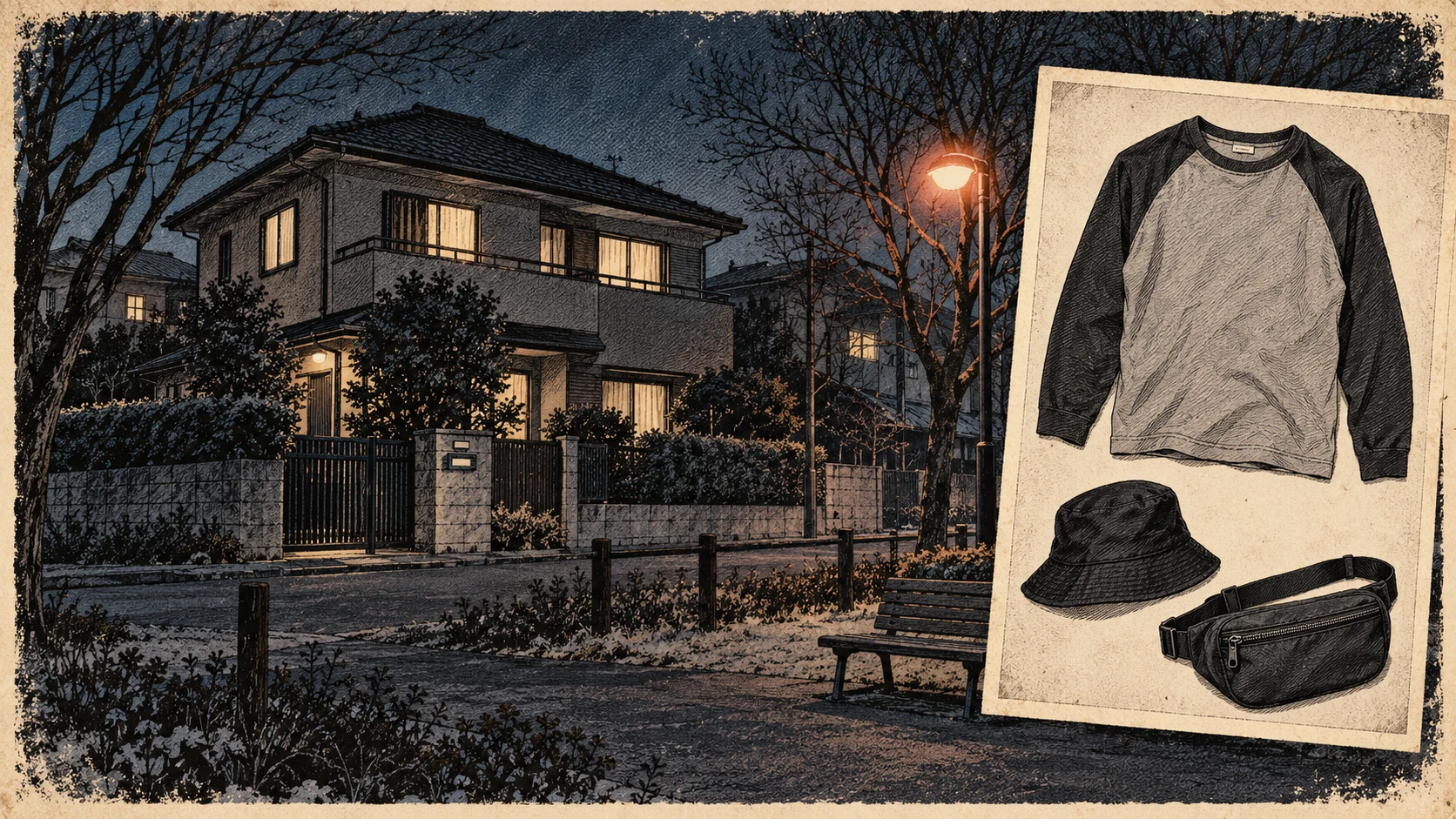
A family of four was killed in Kami-soshigaya, in Tokyo’s Setagaya ward, during the night of 30–31 December 2000. The police continue to document the case through a public appeal. [1]
The surviving objects should not push the family out of the account. Four people were killed. The purpose of examining the evidence is to establish what happened to them. Particularly vivid clues can tempt an audience to treat an investigation as a puzzle whose pieces need only be arranged.
The sweatshirt: uncommon is not unique
Police published details of a sweatshirt whose sales they traced to a small number of items. Their appeal asks about people who owned the same model. It also explicitly explains that possessing a matching garment does not make someone the offender. [1]
That distinction is essential. An uncommon object may narrow an inquiry, but it does not identify an individual. Investigators still need to establish who owned this particular item, whether it changed hands and when it reached the scene. Product information is not yet personal identification.
The bag and its traces
Police also describe a worn hip bag. Sand grains and traces of a fluorescent substance were found inside. A separate appeal gives the characteristics of a scarf. [2]
These details may mean something to a knowledgeable witness without providing outsiders with a complete biography of the killer. Where a product was manufactured is not automatically where its owner came from. Nor can a material trace, without comparison and context, establish a travel history.
What can the handkerchiefs tell investigators?
Police describe a cut in one of the handkerchiefs left behind. They suspect a use involving a knife handle and ask for information from people familiar with a comparable working practice. [3]
An appeal of this kind seeks knowledge that can be checked. It does not prove a particular occupation or nationality. Turning an investigative question into an established description skips the very step that the police are trying to examine.
Why does a large amount of evidence not solve a case by itself?
The number of recovered objects is only one consideration. Each trace needs a reliable connection to a person and an account of how it arrived. More material can create more opportunities for testing, while also raising questions about context.
My starting point is therefore straightforward: which precise proposition can a particular trace test? An object can remain valuable even when its decisive connection has not been established. An unsolved link is a reason to investigate, not an invitation to insert an arbitrary person into the gap.
Frequently asked questions
Have the Setagaya murders been solved?
The police page consulted still carries a public appeal for information.
Does owning the same sweatshirt establish involvement?
No. Police explicitly distinguish a matching model from the individual garment left behind.
Does a product’s country of manufacture establish the killer’s origin?
No. Products are traded, transported and passed between owners.
Books by Christian Hardinghaus

Hooked on True Crime
Why do unresolved cases hold our attention? My book examines internet sleuthing, the search for answers and the responsibility that comes with it.
Explore the book →
Still Lost in Panama
With Annette Nenner, I investigated the disappearance of Kris Kremers and Lisanne Froon. This book follows that separate case in depth; it does not imply a shared explanation for different disappearances.
Explore the book →Panama: digital forensics and timeline · Kris & Lisanne: case lexicon
Sources and context
- Tokyo Metropolitan Police Department: case overview and clothing appeal.
- Tokyo Metropolitan Police Department: hip bag and scarf.
- Tokyo Metropolitan Police Department: possible use of the handkerchiefs.
Research date: 19 October 2026. Linked sources support the attributed facts; discussion of inferences is my editorial analysis. Developments after this date are not anticipated here.