

An archive of unsolved mysteries, where the trail fades into shadow — separating fact from fiction.
Episode 08
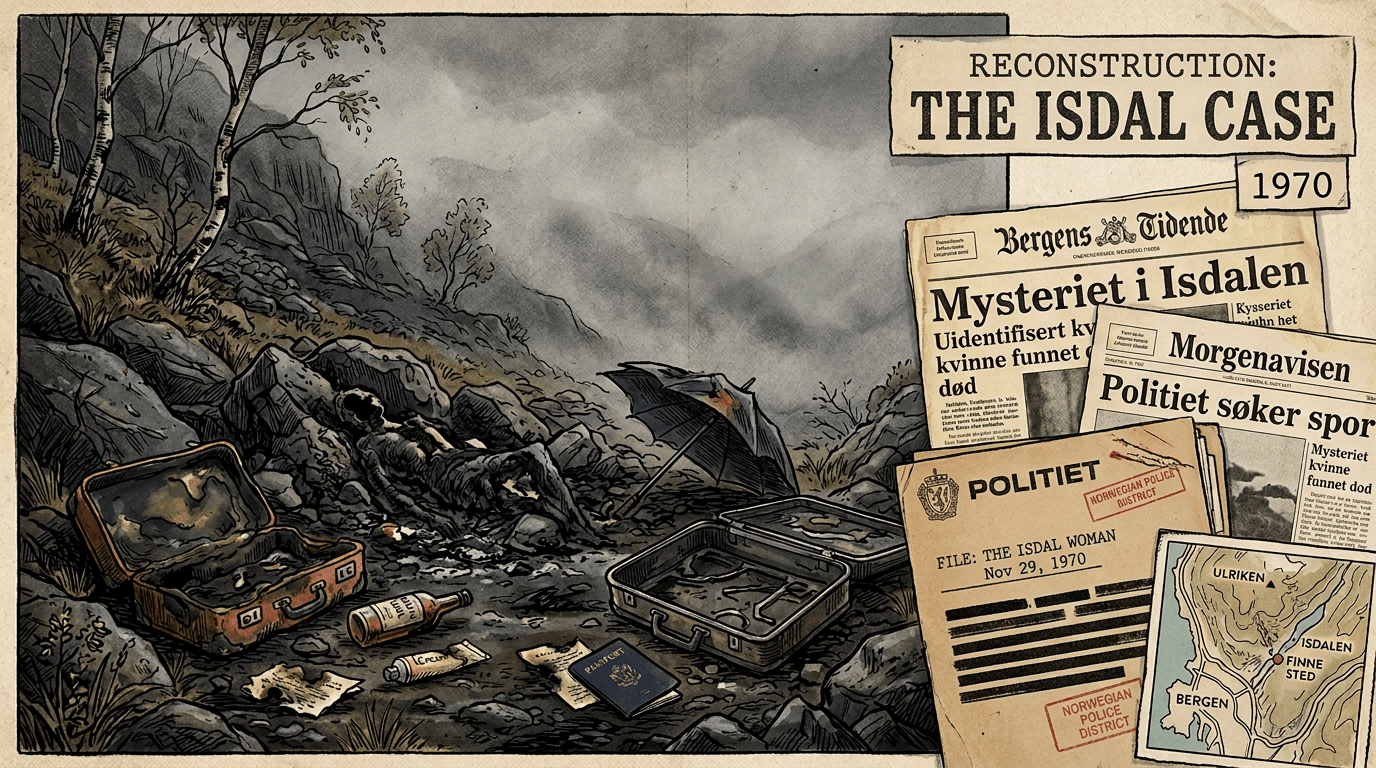
The Isdal Woman: Norway’s Greatest Unsolved Mystery
Fake passports, wigs, coded notes and a burned body in a remote valley near Bergen: the Isdal Woman has baffled investigators for more than half a century. Modern science traced her roots to Germany – but not her name.
Case File at a Glance
On November 29, 1970, a man and his two daughters were hiking through Isdalen, a rocky, remote valley on the edge of Bergen. Locals had long called it “Death Valley” because people had taken their own lives there in earlier times. Among the boulders, they found the partially burned body of a woman. Around her lay charred belongings: a watch, jewelry, scraps of clothing, bottles. There was no ID.
The autopsy showed that she was still alive when the fire started. Her blood contained carbon monoxide and a large amount of sleeping pills, many of them still undigested in her stomach. Who was she? Norway is still asking.
The Suitcases at Bergen Station: A Woman of Many Names
A few days later, police found two suitcases at Bergen’s railway station that were linked to the dead woman. Their contents turned a tragedy into a spy story: wigs, glasses with plain lenses, clothing with every label removed, cash in several currencies and a notebook filled with coded entries. The codes were later interpreted as dates and places of her travels.
Investigators reconstructed that she had crossed Europe under a string of different names, using forged Belgian passports, traveling through Norway, Germany, France and Switzerland. At hotels, she registered as Finella Lorck, Claudia Tielt or Vera Schlosseneck, among others. Staff remembered a well-dressed, reserved woman who spoke several languages, including German, French and English, and who often asked to change rooms.
Suicide or Murder? Isdal Woman Theories
Norwegian police closed the case quickly, concluding it was most likely suicide. Many observers still find that hard to accept. How does someone take a large dose of sleeping pills and then set herself on fire? Why were her belongings arranged so neatly around her? And why would a woman planning to end her life go to such lengths to hide her identity?
The best-known theory is that she was a spy. Norway was testing its new Penguin anti-ship missile at the time, and some of her travel dates appear to line up with test schedules. None of this has been proven. Other explanations range from a woman running from someone to a link to organized crime. No suspect was ever identified.
The German Connection: Was the Isdal Woman From Nuremberg?
In 2016, Norwegian police and the broadcaster NRK reopened the case, and with the BBC produced the acclaimed podcast Death in Ice Valley. An isotope analysis of her teeth delivered a striking result: she was probably born around 1930 and spent her early childhood in or near Nuremberg, in southern Germany, before moving toward the French-Belgian border region.
That means somewhere in Germany there may still be a family who never saw a daughter, sister or aunt again. Investigators created a DNA profile of the woman, but no definitive match has been found so far.
Where the Isdal Woman Case Stands Today
More than 50 years after her death, the Isdal Woman remains unidentified. She was buried in Bergen in 1971 in a zinc coffin, with Catholic rites. Police have never officially revised their original conclusion.
The best hope today lies in genetic genealogy, which has already solved other decades-old cases. One day, the woman from Ice Valley may get her name back – and the decisive clue may well lead to Germany.
This case is documented in our archive
Explore the Isdal Woman alongside 30+ other unsolved cases in the STILL VANISHED True Crime Encyclopedia.
Books by Christian Hardinghaus

Crowdsolving True Crime Files
How web sleuths, podcasters and genetic genealogists reopen real cases. The Isdal Woman shows how new methods breathe life into old files.
Book Details Get on Amazon
Still Lost in Panama
The definitive account of the 2014 disappearance of Kris Kremers and Lisanne Froon in the Panamanian jungle.
Book Details Get on AmazonThis article is based on publicly available sources and is presented with respect for those affected. Where theories or unconfirmed claims are discussed, they are clearly identified as such. It serves informational and documentary purposes. If you have information related to this case, please contact the relevant authorities.