

An archive of unsolved mysteries, where the trail fades into shadow — separating fact from fiction.
Episode 07
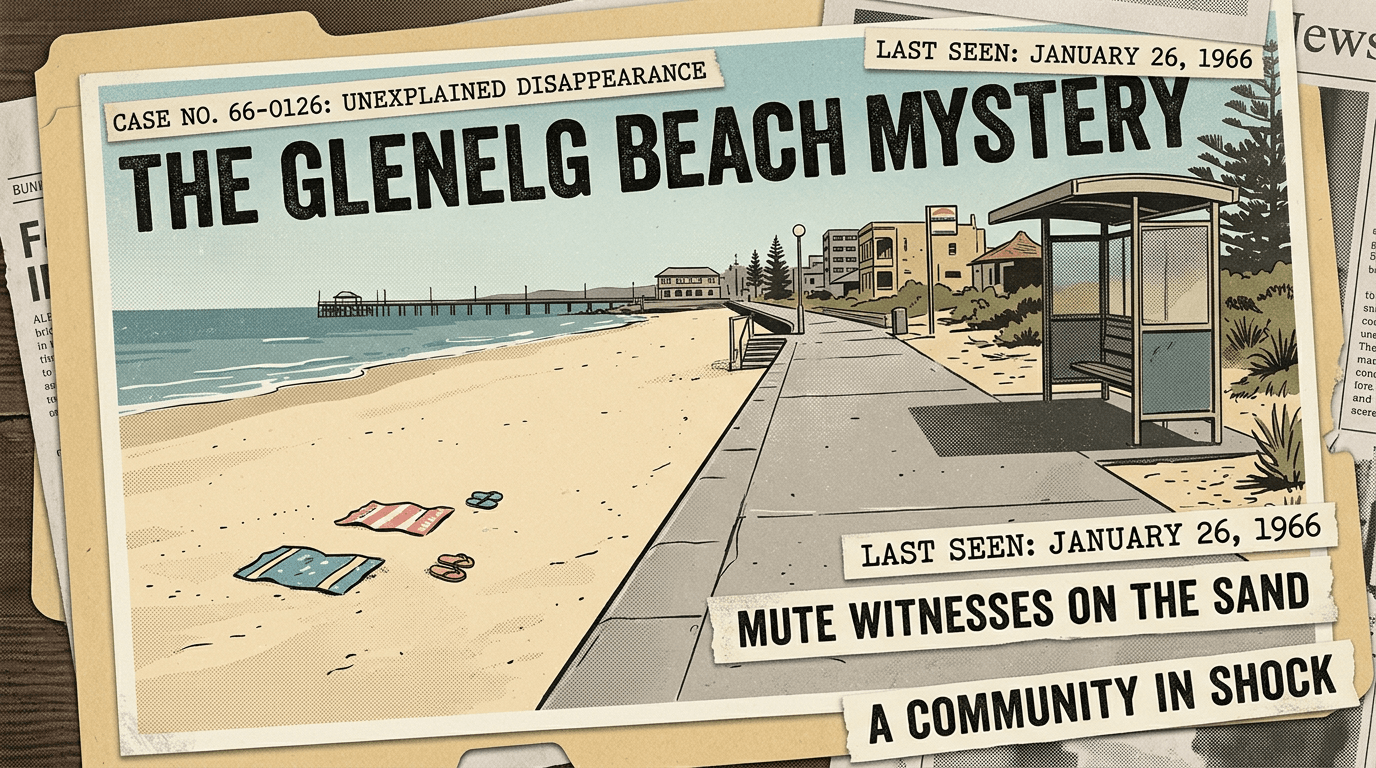
The Beaumont Children: The Beach Trip That Became Australia’s Most Haunting Missing Persons Case
On Australia Day 1966, three siblings left home for a familiar morning at Glenelg Beach near Adelaide. They were seen by witnesses, appeared relaxed, and were expected back by lunchtime. They never returned.
Case File at a Glance
On the morning of January 26, 1966, nine-year-old Jane Beaumont took her younger siblings, seven-year-old Arnna and four-year-old Grant, to Glenelg Beach, a popular seaside destination outside Adelaide, South Australia. It was Australia Day, the weather was warm, and the trip was familiar. The children had been allowed to travel there before, usually by bus, and were expected home around lunchtime.
By early afternoon, however, the Beaumont children had not returned. Their parents, Jim and Nancy Beaumont, first assumed the children had simply missed a bus or stayed longer than planned. As the hours passed, concern turned into alarm. By evening, the disappearance of Jane, Arnna and Grant Beaumont had become a police matter. Over time, it would become one of Australia’s most famous and emotionally enduring unsolved missing children cases.
Why The Beaumont Children Case Still Resonates
The Beaumont children disappearance remains deeply embedded in Australian true crime history because it marked a cultural rupture. For many Australians, the case is remembered as a moment when assumptions about childhood independence, public safety and familiar neighbourhood spaces changed dramatically. Children taking a bus to the beach without an adult was not unusual in 1966. After Glenelg, that ordinary freedom felt different.
The case also continues to resonate because it contains several elements that appear painfully concrete, yet never lead to a final answer: a known destination, daylight witnesses, a narrow timeframe, and reported sightings of the children with an unknown man. Unlike cases where a person vanishes unseen, the Beaumont children were apparently observed after leaving home. That has kept the case alive for investigators, journalists, researchers and generations of readers searching for a missing piece.
In modern terms, the disappearance is often discussed alongside major cold case investigations, missing children cases and unresolved Australian crime stories. But the enduring fascination should not obscure the central reality: three children left for a beach outing and never came home. Every theory begins from that fact, and none has yet replaced it with certainty.
The Morning at Glenelg Beach: Timeline of the Disappearance
Jane, Arnna and Grant Beaumont left their family home in the Adelaide suburb of Somerton Park on the morning of January 26, 1966. They travelled to Glenelg Beach, a place they knew well. Contemporary accounts commonly place their departure around mid-morning, with the children expected to return by around noon or early afternoon.
Witnesses later reported seeing the children at or near the beach. One of the most significant reported observations involved the children in the company of an unknown man. Descriptions varied, as witness descriptions often do, but the man was generally described in accounts of the case as being in his thirties, sun-tanned, and of average build. According to several retellings, the children seemed comfortable with him rather than distressed. That detail has become one of the most discussed aspects of the Beaumont children case, though it remains an interpretation of witness observations rather than proof of what happened.
Another important detail concerns money. The children reportedly bought food near the beach, and questions later arose about whether they had more money than their parents believed they had taken from home. Some accounts suggest this may indicate that someone else had given them money. This point is often cited in theories about grooming or prior contact, but it has never been publicly confirmed as a definitive explanation.
When the children failed to return as expected, Jim and Nancy Beaumont began searching and contacting authorities. Police launched a major investigation. Glenelg Beach, transport routes, nearby streets and possible witness locations became focal points. The scale of public attention grew quickly. Newspapers carried the children’s photographs, witnesses came forward, and tips began to accumulate. Yet none produced the children or a conclusive account of their final movements.
Witnesses, Public Appeals and the Search for Clues
The immediate search for Jane, Arnna and Grant involved police, volunteers and widespread media coverage. In the weeks and months that followed, the case drew enormous public attention across Australia. The Beaumont children were not anonymous missing persons in a distant file. Their faces became nationally known, and the fear surrounding their disappearance entered everyday family conversations.
Investigators followed numerous leads. Some involved reported sightings of the children after January 26. Others focused on the unknown man allegedly seen with them near Glenelg. Over the years, police also examined claims connected to known offenders, possible burial sites, confessions of uncertain reliability and persons of interest. Many leads were investigated repeatedly as new information, new technology or renewed public attention brought them back into focus.
One reason the case remains difficult is the age of the evidence. The disappearance occurred before modern surveillance, mobile phone records, digital payment trails or widespread forensic databases. Much of the early investigation depended on memory, witness timing and physical searches. In a crowded public place on a holiday, even sincere witnesses could be mistaken about times, clothing, identities or sequences of events.
Still, the investigation did not simply fade. South Australian authorities have returned to the case many times. Excavations and searches have been conducted at locations suggested by leads, including sites linked in public discussion to possible suspects or alleged confessions. These searches have not resolved the case. No remains have been conclusively identified as belonging to the Beaumont children, and no one has been convicted in connection with their disappearance.
Theories and Unconfirmed Claims Around The Beaumont Children
Because the Beaumont children case remains unsolved, several theories have developed around the same limited evidence. The most widely discussed theory holds that the children were lured away by an adult male, possibly someone who had gained their trust before Australia Day 1966. Supporters of this theory point to the reported relaxed behaviour of the children around the unknown man and the possibility that they may have had money not accounted for by their parents. This remains a theory, not an established fact.
Another theory suggests an opportunistic abduction by a stranger who encountered the children at Glenelg. In this scenario, the man did not necessarily know the children beforehand but exploited a brief window of access, public trust and the independence children were often given at the time. This theory fits the broad outline of the disappearance but does not explain all reported witness details with certainty.
Some researchers have explored links to known or suspected child offenders active in Australia during the broader period. Names have circulated in books, documentaries, podcasts and online forums. Some of these people were investigated, publicly discussed or named as persons of interest in media reporting. However, no suspect has ever been legally established as responsible for the disappearance of Jane, Arnna and Grant Beaumont. It is important to separate public suspicion from proof.
A further set of claims concerns alleged burial locations or confessions. Over the decades, police received tips suggesting the children may have been taken to particular properties or buried at specific sites. Searches at some locations drew significant public attention, especially when excavation work was carried out. These efforts show how seriously some leads were treated, but they did not produce a definitive resolution. Unconfirmed claims, even when dramatic, remain unconfirmed unless supported by evidence.
The most speculative versions of the case sometimes connect the Beaumont children to broader conspiracy claims or unrelated disappearances. Such theories appear periodically in true crime communities because unresolved cases invite pattern-making. At present, these claims should be treated with caution. The known facts support a narrower conclusion: the children disappeared after travelling to Glenelg Beach, witnesses placed them in the area, and an unknown adult male remains central to many interpretations of the case.
How the Case Changed Australia’s View of Childhood Safety
The disappearance of the Beaumont children is often described as a turning point in Australian social history. That description can be overstated if treated as a single moment that changed everything overnight, but it captures something real. The case became part of a growing awareness that familiar public places were not automatically safe simply because they were local, busy or known to the family.
Parents across Australia saw themselves in Jim and Nancy Beaumont. The children had not run away into a distant unknown world. They had gone to the beach, a normal and permitted outing. The horror of the case lay partly in that normality. It suggested that danger could enter ordinary routines without warning and leave almost no trace.
For investigators and criminologists, the case is also significant because it sits at the intersection of witness-based policing and modern cold case review. Had the disappearance occurred today, investigators might have access to CCTV, transport card records, phone location data, digital photographs, automatic number plate recognition or rapid public alerts. In 1966, the investigation relied on human observation and the speed at which information could be gathered, printed and broadcast.
Where The Beaumont Children Case Stands Today
Jane, Arnna and Grant Beaumont remain missing. The case is still remembered as one of Australia’s most important unresolved missing persons investigations. Police have periodically reviewed the file, assessed new information and followed leads. Public interest has also remained high through books, documentaries, news features, podcasts and online true crime research.
The passage of time has made resolution more difficult. Many original witnesses, investigators and potential suspects have died. Memories fade, records age, and physical evidence becomes harder to locate. At the same time, cold cases sometimes shift unexpectedly when new forensic methods, archival discoveries or credible late-life disclosures emerge. That possibility is one reason the Beaumont children case has never fully left public consciousness.
What can be said with certainty is limited but devastating: on January 26, 1966, three siblings travelled to Glenelg Beach and did not return home. They were seen by witnesses in the area. Reports of an unidentified man remain central to the public understanding of the case. Despite decades of investigation, no confirmed explanation has been established, no remains have been found, and no person has been convicted.
For readers searching for “The Beaumont Children,” “Glenelg Beach disappearance,” or “Australia’s most famous missing children case,” the mystery often begins with the same question: how could three children vanish in daylight from a popular beachside suburb? Nearly sixty years later, the answer remains somewhere between memory, silence and the long shadow cast by one summer morning.
This case is documented in our archive
Explore The Beaumont Children alongside 30+ other unsolved cases in the STILL VANISHED True Crime Encyclopedia.
Books by Christian Hardinghaus

Crowdsolving True Crime Files
18 international cold cases explored in depth — plus a bonus collection of 20 lesser-known German cold cases rarely covered in English.
Book Details Get on Amazon
Still Lost in Panama
The definitive account of the 2014 disappearance of Kris Kremers and Lisanne Froon in the Panamanian jungle.
Book Details Get on AmazonThis article is based on publicly available sources and is presented with respect for those affected. Where theories or unconfirmed claims are discussed, they are clearly identified as such. It serves informational and documentary purposes. If you have information related to this case, please contact the relevant authorities.