

A sailing trip, a storm and an apparently deserted liner: Triangle starts like a ghost-ship story, then becomes a trap whose most dangerous element is Jess herself. By the ending, asking where it all began may already be the wrong question.
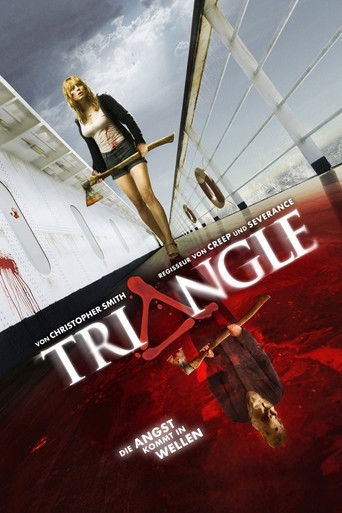
Triangle (2009)
Director: Christopher Smith
Cast: Melissa George, Michael Dorman, Liam Hemsworth
The ending in brief
Jess gets off the ship but does not escape the repetition. Her return home and journey back to the harbour belong to the cycle. Reading the taxi driver as Death, and the voyage as punishment, is persuasive interpretation rather than an explicitly confirmed explanation of every event.
How does the time loop work in Triangle?
The crucial shift occurs when Jess watches the group approaching the liner again: another Jess is arriving. The hunted woman becomes an observer of her own arrival. Later, she takes on the masked attacker’s role, having previously fought that figure herself.
Two things need separating. We follow one Jess through a succession of experiences, but the ship contains several versions at different stages of that succession. “The day simply starts again” is therefore too crude. Different memories and intentions enter the same situation.
- Jess boards the liner believing an unknown attacker is stalking the group.
- She witnesses their repeated arrival and tries to change what happens.
- Hoping to get home, she becomes an attacker herself.
- After going overboard, she reaches land again.
- Her attempt to put things right at home leads to the crash and another journey to the harbour.
This follows her perspective; it is not a complete numbering system for every version of Jess. Their unequal knowledge is precisely what makes the liner difficult to untangle.
Why does Jess board the yacht again?
She still treats the voyage as a chance to rescue Tommy. The film gives her no straightforward new future in which she accepts responsibility and lives with what happened. Her desire points backwards: surely there must be a version in which her son survives.
My reading is that Jess confuses repetition with making amends. She wants to remove her cruel earlier self and become a better mother. Yet her attempted correction is itself violent. The apparent fresh start uses the very means she would need to abandon. That makes the final return more painful than a clever narrative trick.
What do the seagulls, keys and bodies mean?
Accumulations of identical objects and bodies challenge Jess’s sense that she is facing a unique emergency. She is not the only thing that returns: traces of earlier passages remain. The birds outside the liner extend that idea beyond the ship. Crossing the railing was not the same as escaping.
These details should not be forced into a perfect physics equation. Triangle does not provide a testable theory of time travel. Its imagery establishes something more immediate: Jess encounters the consequences of repetition even where she believes she is free.
Is the taxi driver Death?
He can be read as a ferryman. After the crash, he takes Jess to the place where her journey starts again. In that interpretation, her promise to return acquires the force of an agreement with Death, while the liner becomes a space between life and final acceptance.
A supernatural reading, in which the loop genuinely exists within the film’s world, remains possible. Another reading treats the voyage as an expression of guilt and psychological collapse. In his IndieLondon interview, Christopher Smith explicitly welcomes different interpretations. That does not support presenting one answer as the sole authorised solution. [1]
Why Sisyphus matters to the ending
The liner’s name, Aeolus, and the film’s reference to Sisyphus connect its events with futile repetition. The powerful idea is not just endless labour, but a task that keeps renewing hope without delivering release.
For me, the deepest horror is not that Jess has yet to master every rule. It is that every discovery becomes another plan for defeating the past. She learns more about the trap while clinging to the hope that keeps her moving through it.
If you liked this film
From film puzzles to reading
The Key to Mulholland Drive
As in Lynch’s cinema, it helps to distinguish recurring imagery from the events of the plot. My book develops that approach through Mulholland Drive.
This Book Lies to You
For readers who want to experience uncertain ground in fiction, this is the natural next step after the film.
Triangle: ending FAQ
Is Jess dead in Triangle?
The afterlife and ferryman interpretation suggests this, but the film does not confirm one unambiguous status that settles every layer.
Why are there multiple versions of Jess?
Different stages of the cycle overlap on the liner. Jess encounters versions of herself with different memories and intentions.
Does Jess save Tommy?
The ending shows no successful rescue. Jess returns to the voyage rather than reaching a visibly changed future.
Film and sources
Primary work: Triangle (2009), Christopher Smith.
This is an editorial analysis. Interpretations are identified as readings; comments by the director are attributed separately, and unresolved questions remain open. Poster: the TMDB image already used in the encyclopedia.